Boyfriend trousers: the shoe decides elegant or sloppy
In short
Loose tailored trousers fail at two points: the waistband and the ankle. A shoe-by-shoe formula for loafers, boots, and sneakers, plus the fit checks that matter.
- Measure the trouser's leg opening: under about 22 centimetres it needs a shoe with visible instep, and over about 24 centimetres it needs a wider shoe or a heel.
- Take in the waistband to the natural waist and choose a mid-weight wool or firm cotton twill, because a gaping waist or collapsing fabric is what makes the trouser look borrowed.
- Hem wide trousers to the ankle bone or one centimetre above it for loafers, and allow a two to three centimetre gap around a narrow ankle boot shaft.
By Cici
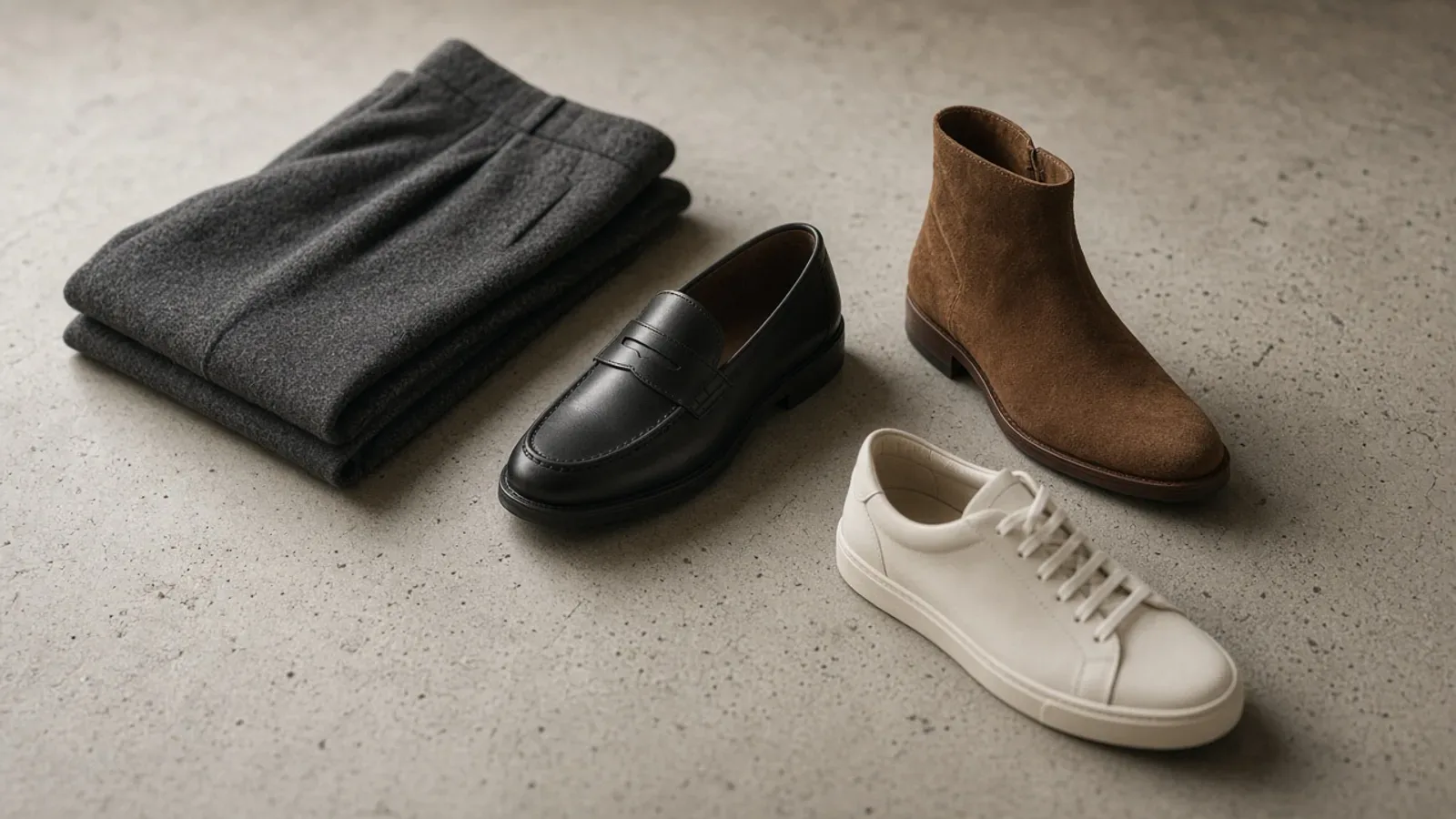
The boyfriend trouser fails at one of two junctions. Either the waistband gapes and drags the crotch down until the whole leg looks borrowed, or the extra fabric at the ankle meets a shoe too small to carry it and collapses into a puddle. Fix those two points and the rest of the outfit is close to automatic. Leave them and no amount of careful accessorising rescues the silhouette. You have seen both versions on the same street: one pair looks borrowed from someone taller and more relaxed, the other looks chosen.
Relaxed tailoring is not the same as a bigger size
A relaxed trouser and a trouser two sizes too big can hang on the body in almost the same way, and the difference is almost entirely in the waistband. A pair cut on a woman’s block has a waistband-to-hip ratio designed to sit on the hip bone and stay there, with the volume released below the hip so the leg falls straight. A pair lifted from the men’s department has a straighter ratio, which is why it slides, why the crotch hangs low, and why it reads as costume rather than clothes. If your waistband needs a belt to stay up, the trousers are the wrong size, not the right attitude.
The shoe carries the volume
| Trouser detail | What to look for | Why it matters |
|---|---|---|
| Leg opening under 22 cm | A shoe with visible instep | The fabric sits close to the ankle and the eye needs a landing point |
| Leg opening over 24 cm | A wider shoe or a heel | The hem must lift off the ground to keep its line |
| Loafer hem | The ankle bone or 1 cm above it | Full length hides the vamp, and mid-calf turns it into another garment |
| Ankle boot shaft | A 2 to 3 cm gap inside the hem | A shaft that catches the fabric creates a lump |
| Sneaker sole | Under 3 cm | A thicker sole raises the hem and shortens the leg |
| Waistband | Taken in to the natural waist | A fifteen-minute fix that removes the slouch |
The useful question is not which shoe is in fashion this month but whether it is heavy enough, or precise enough, to answer the trouser’s width. A wide leg opening over a flimsy flat produces the puddle. A narrow ankle over a bulky boot produces a caricature of a leg. Stand in front of a full-length mirror in the shoes you actually wear and look at your ankle rather than your waist; the problem is almost always down there.
Measure the circumference of the leg opening before you buy, and treat the numbers as a starting point rather than a law, because they shift with your height and leg length. The principle behind them is simple: the shoe’s visual weight should roughly match the trouser’s.
The same logic governs jeans with a curved leg, which is why the shoe rules for barrel jeans transfer almost directly here.
Loafers: the vamp does the work
The penny loafer is the most reliable partner for a relaxed trouser, and the reason is structural. A loafer exposes the top of the foot, a small horizontal line of skin or leather that breaks up the vertical mass of a wide leg. Without it, a full-length wide trouser reads as a column from waist to floor.
Hem the trouser to hit your ankle bone or a centimetre above it. Not cropped to mid-calf, which turns the trouser into a different garment entirely, and not full length, which will break across the loafer’s vamp and hide the detail that made the pairing work. A slight heel of two to three centimetres lifts the hem just enough to keep it clear of the pavement when you walk.
A chunky lug sole is the wrong call here. It adds weight at the bottom of your foot, where the trouser already supplies weight, and the two compete.
Ankle boots: the gap matters
An ankle boot under a wide trouser works only when the boot shaft is narrow enough to sit inside the hem, or wide enough that the trouser falls over it cleanly. The failure mode is in between: a shaft that catches the hem, pushes the fabric out, and creates a lump at your ankle that no amount of smoothing fixes.
Aim for a gap of two to three centimetres between the widest part of the boot and the inside of your trouser leg. An almond or softly pointed toe extends the line of the leg better than a round one, because the eye follows the point under the hem. A block heel of four to six centimetres is the practical ceiling before the outfit stops being a walking outfit.
Low-profile sneakers, not running shoes
A leather sneaker with a slim sole, under roughly three centimetres thick, can hold a wide trouser if the hem is short enough to show it. The problem is depth: a thick-soled retro trainer raises the hemline and shortens the leg, and the chunky profile repeats the trouser’s volume at the opposite end of your body. If sneakers are the plan, you want a clean, flat front and a hem that stops at the top of the shoe with no more than a single soft break.
Socks matter more than they should. A visible white sock under a wide dark trouser creates a horizontal band at the thinnest part of your leg, which is precisely where you do not want the eye to stop.
Fit checks before anything else
Three things determine whether relaxed trousers read as tailored or as slept-in.
The rise should sit at or above your navel. A high rise holds the volume away from the thigh and keeps the leg falling straight. A low rise lets the fabric hang from the hip, which is where the slouch starts. Try the pair on sitting down in the changing room: if the waistband digs into your stomach when you fold, it will be unbearable by lunchtime.
The waistband should be taken in to your actual waist. It is a fifteen-minute alteration, most tailors will do it while you wait, and nothing else compensates for a gaping back waist.
Fabric weight should be substantial enough to hold a crease. A mid-weight wool or a firm cotton twill drapes; a thin viscose or a soft jersey clings and shows every line beneath it. If the fabric collapses when you hold the trousers up by the waistband, they will collapse on your body.
Finally, the hem. Take the trousers to be altered with the shoes you will wear with them, because the correct length for a loafer is wrong for a boot. This is the same logic behind a three-shoe rotation: decide the shoes, then cut the cloth.
Two outfits that hold up
For work: a charcoal wide-leg wool trouser with a defined waistband, a fine-knit crew neck tucked in, a black leather loafer with a two-centimetre heel, and a single long coat. The coat is the third piece, and it matters more than usual because a wide trouser without a layer above it can look unfinished.
For a Saturday: an oatmeal or stone trouser in a heavier cotton, a plain white tee, a slim-soled leather sneaker, and a cropped jacket that stops at the hip bone. The short jacket shows the waistband, which is the whole reason the trouser works on you.
Both outfits run on the same rule, and it is worth applying the cost-per-wear arithmetic before buying: a trouser that only works with one shoe is a trouser you will wear a third as often as one that works with three.
Before buying another pair, walk to the mirror in the shoes you already own and look at your ankle. If the hem swallows the shoe, the fix is a tailor, not a new wardrobe. If the shoe disappears entirely, your trousers are too long by three centimetres, and that is the number to take to the alterations this week.
Direct answers
Frequently asked questions
What shoes work best with boyfriend trousers?
Loafers with a small heel, narrow-shaft ankle boots with an almond toe, and slim-soled leather sneakers. The shoe needs enough visual weight to answer the trouser's width, or enough exposure at the instep to break up the line of a wide leg.
How long should wide-leg trousers be?
Hem them to the top of the shoe with no more than one soft break, or to the ankle bone for loafers. Have them altered while wearing the shoes they will be worn with, since the correct length for a boot differs from the correct length for a flat.
How do you stop boyfriend trousers looking sloppy?
Take in the waistband so it sits at the natural waist, choose a fabric heavy enough to hold its shape, and match the shoe to the leg opening. Most of the sloppiness comes from a gaping waist or a hem that pools on the ground.
Can you wear sneakers with tailored wide-leg trousers?
Yes, if the sneaker has a slim sole under roughly three centimetres and the hem is short enough to show it. Thick-soled trainers raise the hemline and repeat the trouser's volume at the foot, which shortens the leg.
Filed under
About the author

The editorial voice of CiciTrends. Color, fit, and the small decisions that make a wardrobe work. Written by an AI-assisted desk under human direction.
Reporting, sourcing and AI disclosure:/editorial-standards/
Keep reading
Related stories
The outfit formula: three templates that end decision fatigue
Stop solving the same outfit puzzle every morning. Three repeatable formulas, how to adapt them, and why variety is overrated on a Tuesday.
Jan 3, 2026
The three-shoe rotation: fewer pairs, more wear
An everyday pair, a weather pair, and a smart pair cover most of the week. The fit rules, the rotation, and when to replace them.
Jan 3, 2026
The in-between wardrobe: winter to spring without the panic
It is 40 in the morning and 65 by lunch. A three-layer system, the pieces to keep out, and a weekend swap that does not require a new wardrobe.
Jan 6, 2026