Mixed metals: the 70/30 rule that replaces the gold-or-silver test
In short
The gold or silver test dead-ends on a real jewelry box. A working rule for mixing metals: a 70/30 split, one repeated finish, and a bridge piece that works.
- Let one metal carry about 70 percent of what is visible and the second appear once; 60 keeps the eye flipping between two carries and 80 shrinks the minority tone to a dot.
- Pieces you never remove, such as an engagement ring or a daily watch, sit outside the 70/30 split and read as part of the body rather than as styling.
- Judge the mix from three feet back or on a small photograph: whichever metal you notice first is carrying, and noticing both at once means one piece comes off.
By Cici
The test that stalls
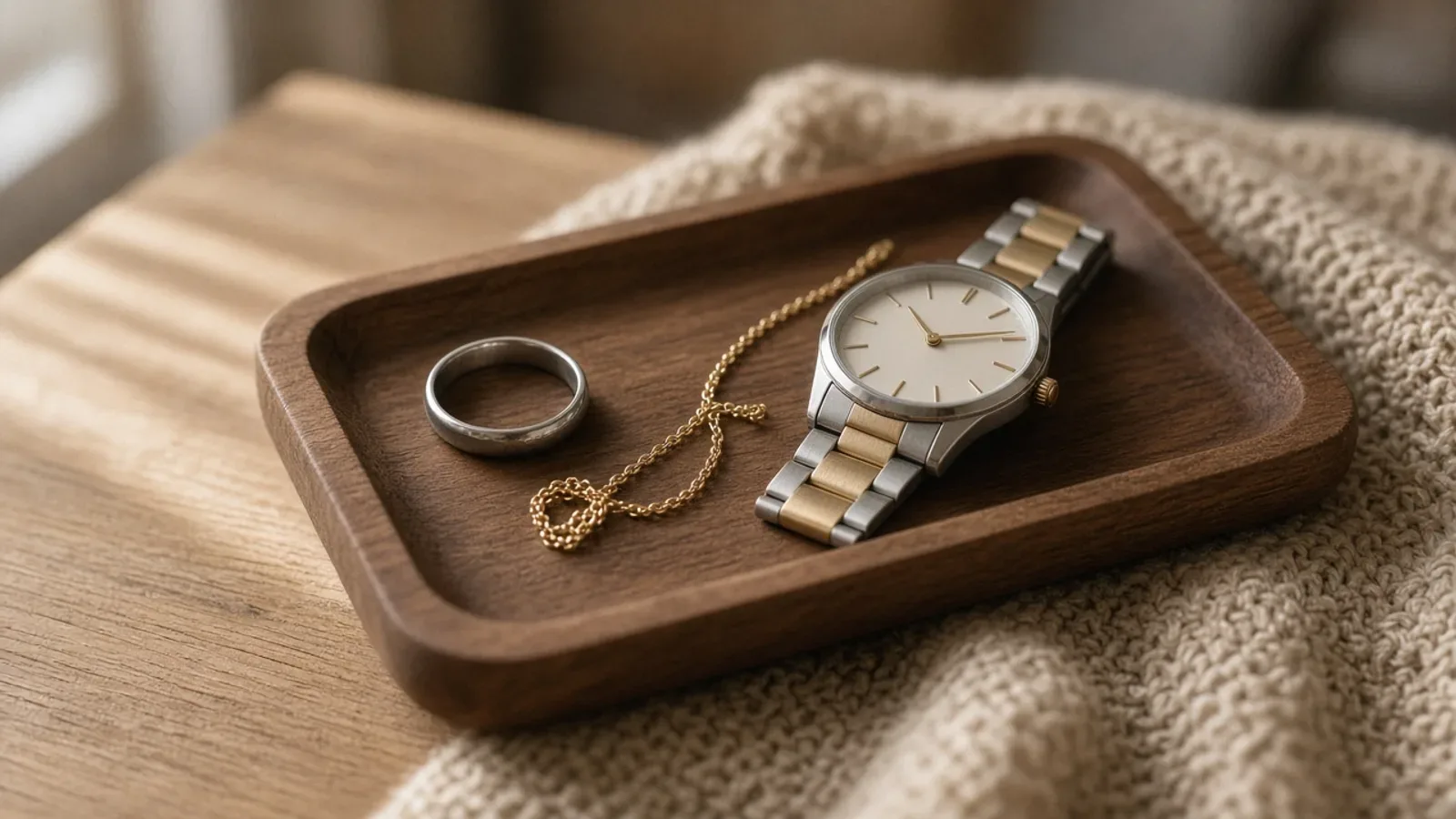
Mixing gold and silver works when one metal carries about seventy percent of what is visible, the second shows up once, and a single piece carries both tones so the eye has somewhere to travel. That split is why a platinum ring and a pair of gold hoops can sit on the same hand and look deliberate instead of undecided.
You are at the bathroom mirror at 7:50 on a Tuesday, one gold hoop in, one hand on a platinum ring you have not taken off in six years. The vein test said cool. The white paper test said warm, depending on which bulb is doing the work, and the bulb in there is bad. You put the second hoop in anyway and spend the commute wondering whether you look like you got dressed in the dark.
That is where the gold-or-silver test dead-ends. It answers something you settled years ago, by getting engaged, or inheriting a chain, or buying a watch you liked in a case and then wearing it every day since.
The undertone test is a decent way to choose a first pair of earrings. It is a useless way to describe a drawer. I do not think the test is wrong. I think it is being asked to do a job it was never built for.
The women I know who struggle with this are not mistyped. They are correctly typed, and then handed a necklace that quietly disagrees with the ring they never remove. The typing was never the part that got them dressed.
Inventory what you cannot take off
Before any shopping, do the boring part. Empty the drawer onto a towel and put three things at the top: the ring you never remove, the watch you wear most, and the piece that came from someone.
Those three set the metal of your life. A platinum or white gold setting reads cool and bright. White gold is gold alloyed with nickel or palladium, copper and zinc, and most of it is rhodium plated, so the brightness you are matching against is often a thin surface that wears at the edges over a few years (GIA’s guide to white metals has the alloy numbers). A steel watch case reads cool and faintly gray. A grandmother’s chain in 14k reads warm and soft, and it has likely gone a little buttery with wear. A five-year-old white gold ring often looks brighter and cooler than the one beside it in the case, and that is a thing to notice with your eye rather than solve with a chemistry lesson.
You know this moment: the assistant lifts a white metal chain toward your neck and says “see how that brightens you,” and you cannot tell whether it does or whether you simply want to leave the shop.
The reframe that saved me money is this. The fixed pieces are a fact, not a preference. You are not choosing a metal. You are choosing what gets to sit next to the metal you already own. That takes about four minutes and costs nothing.
My rule is the drawer, not the season. If a piece never leaves your body, it is not part of the mix. It is part of you, and everything else negotiates around it.
Seventy/thirty, not fifty/fifty
| Piece in the mix | Counts toward the ratio? | Why |
|---|---|---|
| Platinum or white gold engagement ring, never removed | No | A fixed piece reads as part of you, not as styling |
| Steel watch worn most days | No | It sets the cool tone that everything else negotiates around |
| Gold hoops carrying the minority tone | Yes | It appears once and echoes something else you are wearing |
| Oxidised silver chain beside yellow gold | No, it is the bridge | It carries both tones in one object |
| A second full set in the other metal | Yes, and it breaks the split | It buys fifty-fifty instead of proportion |
There is a feeling I know from the hall mirror at ten past eight, coat on, keys in hand, something at the wrist still not settled. Not wrong. Unfinished. That feeling is almost always fifty-fifty.
Fifty-fifty reads as a coin toss. It only works when the two metals are physically joined, in a two-tone watch or a chain built to carry both, because the join turns them into one object. Two separate metals in equal measure on the same wrist look like a decision nobody finished.
Seventy-thirty reads as intent. One metal carries the outfit. The second appears once and echoes something else you are already wearing.
To find your carry, stand three feet back from a full-length mirror and squint, or photograph yourself from across the room and look at the picture on a small screen. Whichever metal you notice first is the one carrying. If you notice both at once, you are at fifty-fifty, and one piece should come off. The hall mirror at dusk is a fair test. A flattering photograph at noon is not.
Why seventy and not sixty or eighty. At sixty the eye keeps flipping between two carries, which is the coin toss again with extra steps. At eighty the second metal shrinks to a single dot that reads as an accident, or as the one thing you forgot to take off. Seventy keeps the minority tone visible at three feet without letting it compete.
It is distance that does it. At three feet, a gold hoop is a warm dot, not a karat weight. At eighteen inches it is a material with a finish and a history. Most people see your outfit at three feet, all day, in rooms with worse light than your bathroom.
This is also where scale starts overriding tone. Once gold is big, architectural and worn over fabric, it behaves as contrast rather than as warmth, which is the whole argument in bold gold and the point where undertone stops applying.
The bridge piece does the work
Start with the chain at the bottom of the drawer. You wore it the whole winter you bought it, then the gold hoops arrived, and it went into the dish and stayed there because it looked wrong next to them. Pull it out on a Saturday morning, put it on with the hoops, and look at yourself from across the room rather than up close.
That is usually the piece that ends the argument, because oxidised silver has lost the blue-white edge that makes bright silver fight warm gold and sits closer to gold’s value.
A bridge is any piece that carries both tones in one object, and it is what stops a mix looking accidental. Three that work for different reasons.
Brushed finish. Texture absorbs shine, so the eye reads surface rather than a temperature clash. One polished piece and one brushed piece read as layering, which is what you want. I would buy the version that looks faintly dull in the case; anything shinier is jewellery for a photograph.
Two-tone links. The literal version. It works when the links are small enough that neither tone dominates at three feet. A chunky two-tone bracelet at close range can look like two bracelets in an argument.
I would buy the bridge before buying anything else, and I would buy it once. A single brushed or two-tone chain does more for a drawer of mismatched pieces than a second set of earrings in the other metal.
Three outfits, and the two ways it goes wrong
Jeans and an oatmeal knit, Saturday. Steel watch carrying, gold hoops as the thirty, nothing else. It works because the knit is warm, so the gold has something to agree with. Swap the knit for cool gray marl and the same hoops become the only warm note in the frame, which is the first failure mode: one lonely temperature reads as an error rather than a choice. Fix it with an echo, not more jewellery. A tan leather tab, a camel scarf, a warm lip. The colors that drain you covers the same logic on a larger scale.
Charcoal coat, wool scarf, school run. Gold chain at the neck carrying, platinum ring on the hand. The ring does not count against the ratio. It is a fixed piece, and small fixed pieces read as part of the body rather than part of the styling.
Evening. Gold earrings, gold cuff, platinum ring, no silver anywhere else. Two metals, one shine level, gold carrying. The second failure mode lives here: three metals at three different shine levels. Polished gold, matte silver and a brushed steel watch together give the eye nothing to group. Cap yourself at two shine levels and the mix settles immediately.
So what actually gets bought. One bridge chain, brushed or two-tone. One small pair of earrings in your thirty percent, if you do not own any. Then stop. Do not buy a second full set in the other metal to solve the problem, because the problem was never a shortage. It was proportion.
Check any addition against the cost per wear formula before you commit, since a chain that bridges but never gets worn is a more expensive version of the confusion you started with.
Tonight, empty the drawer onto a towel. Name the three pieces you never remove. Decide which metal carries the rest. Put one bridge in the dish by the door, and leave the other five things where they are.
Direct answers
Frequently asked questions
Can you wear gold and silver jewelry at the same time?
Yes, and most women already do without noticing, because a platinum ring or a steel watch rarely comes off. The workable approach is proportion rather than permission: let one metal carry roughly seventy percent of what is visible, let the second appear once, and use a brushed, two-tone or oxidised piece so the two tones meet somewhere.
Does the 70/30 rule apply to my wedding ring?
No. Pieces you never remove, like an engagement ring or a watch you wear daily, sit outside the ratio. They read as part of you rather than as styling, so a platinum ring does not push you into a fifty-fifty mix. Choose the carry metal from everything else.
What is a bridge piece in mixed metals?
A single item that carries both tones: a two-tone chain, a brushed band, or an oxidised silver chain worn next to yellow gold. It gives the eye a place to travel between the warm and cool notes, which is what separates a deliberate mix from an accidental one.
How do I check my mix before leaving the house?
Stand three feet back from a full-length mirror and squint, or take a photo and view it small. Whichever metal you notice first is carrying. If you notice both at once, take one piece off. Distance is the test, because distance is how everyone else sees you.
Filed under
About the author

The editorial voice of CiciTrends. Color, fit, and the small decisions that make a wardrobe work. Written by an AI-assisted desk under human direction.
Reporting, sourcing and AI disclosure:/editorial-standards/
Keep reading
Related stories
Bold gold: the point where the undertone rule stops applying
Once gold jewelry is large, architectural, and worn over fabric, contrast and scale matter more than undertone matching. How to style bold gold off-undertone.
Nov 5, 2026

The five-piece workweek capsule
Five pieces, ten outfits, one workweek. A capsule that works because the colors do, not because you own more. Includes the matrix and what to spend on.
Nov 4, 2026
Visible mending: make the repair part of the piece
Sashiko, decorative darning, and creative patching turn damage into a design decision. A beginner's guide to the techniques, the kit, and the first project.
Jan 3, 2026