The High-Low Uniform: One Hard Thing Makes Sweatpants Work Outside
In short
Gray sweatpants and hoodies leave the house when one hard element, a coat, a metal, a sleek shoe, does the work. Three formulas and a quick mirror test.
- A heavyweight cotton fleece of about 300 grams per square metre and up falls in a straight line from hip to ankle; if daylight shows through it, the fabric will bag at the knee.
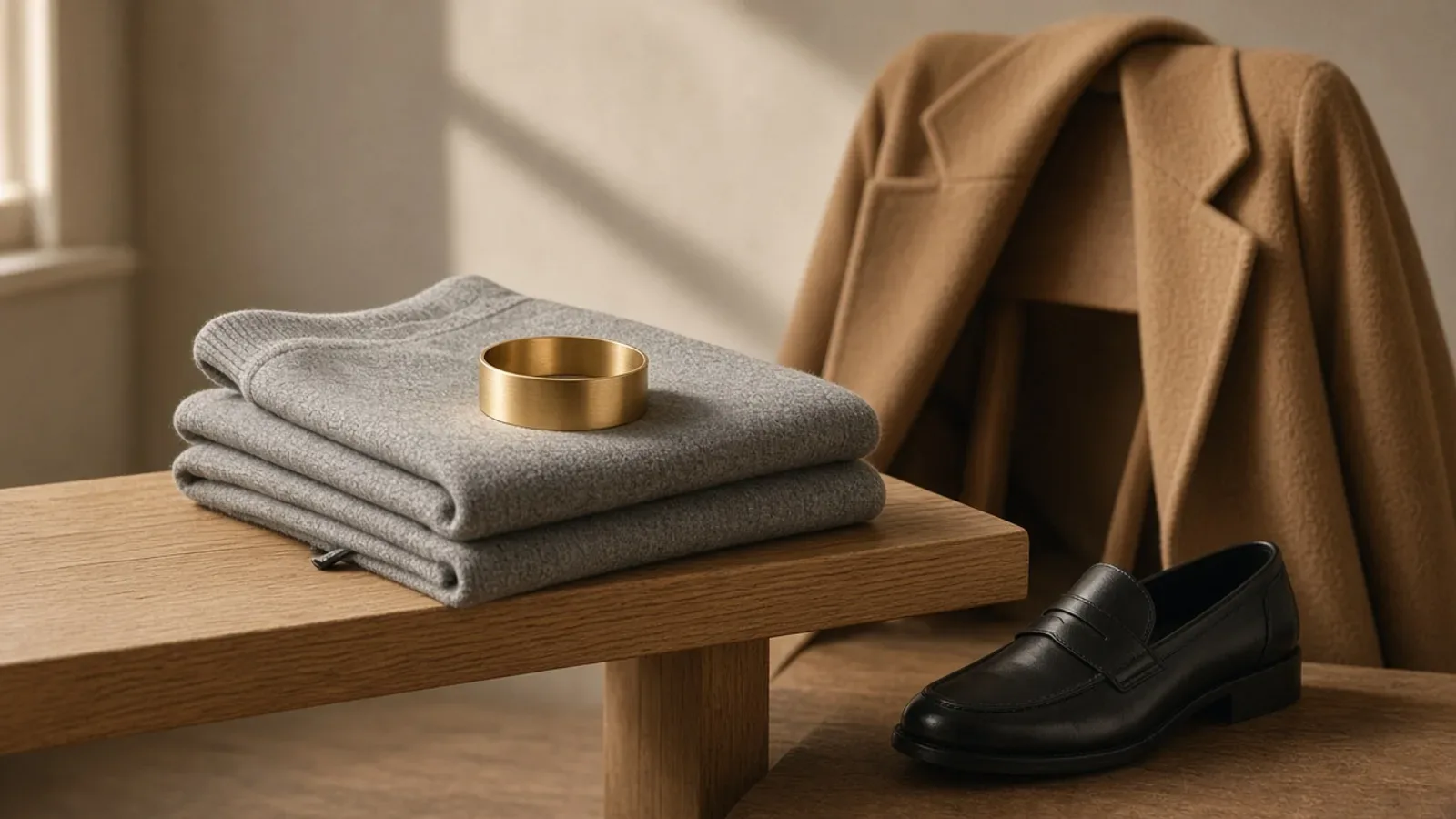
- Soft pieces need one genuinely hard element visible from three feet away: a structured coat shoulder, a wide cuff, or a loafer with a heel, because a fine chain gets swallowed by fleece.
- Use the two-second squint test at the door: stand back, unfocus, and if you cannot find one hard line in the frame, add a cuff, a coat or a bag that stands.
By Cici
The problem was never the color
Gray sweatpants look genuinely pulled-together outside the house when three details line up: a heavyweight matte cotton jersey that holds its leg line, an ankle break that skims the top of your shoe instead of puddling on it, and one tailored outer layer with real shoulder structure. Everything else can stay soft, because those three details do the deciding for you.
Saturday, 8:40 in the morning, keys in your hand, and the hallway mirror catches you on the way past. Gray sweatpants. Hoodie. Hair you did not touch. Nothing is wrong and nothing is decided, and that undecided feeling is the exact thing you were trying to get away from.
The snag was never the sweatpant. It is that everything in the frame is soft: soft jersey, soft fleece, soft hair, a tote with no bones to it. Softness with nothing pressing back reads as a default. It says you did not choose this. It says you did not change. Contrast is the fix, not color, and the contrast has to be readable from three feet away in a hallway mirror.
Why softness needs something to push against
Put on gray sweatpants and change nothing else and you get the same result as black sweatpants with nothing else changed. Neither pair does the work alone. You know the woman at drop-off who somehow looks like she has somewhere to be after this, even when she does not. Watch her for a second. It is almost never the sweatpant. It is the coat she did not take off in the car, or the cuff she put on at the last red light.
That is why a color story is a trap. It sends you out to buy a second pair when what you needed was a bracelet already sitting in the drawer.
The fabric is the part nobody mentions. Heavy cotton fleece, the kind that hangs around 300 grams per square metre and up, has enough body to fall in a straight line from hip to ankle. The thin stuff that comes folded flat in a plastic sleeve bags at the knee within an hour and pools on the top of your foot. Hold a pair up to a window before you buy. If you can see daylight through it, it will not hold a line. The same test works for jersey: matte surfaces read as cloth, and anything with a sheen reads as gym.
One hard thing, and why it has to be hard
| Hard element | What it does to the silhouette | Works over |
|---|---|---|
| Structured wool coat | Gives a shoulder line and a hem that holds | Sweatpant and hoodie |
| Chunky hoop or wide cuff | Interrupts the fleece outline and casts a shadow | Any matching set |
| Loafer with some heel | Puts a hard shape at the ankle | Track pant or cropped sweatpant |
| Tailored trouser | Adds a crease and a hem that reaches the shoe | Hoodie |
| Bag that stands on its own | Adds a hard edge at the hand | School run and errands |
Look at the outline of what you have on. Cotton fleece collapses. No shoulder, no hem that holds, no edge anywhere. That is exactly why it feels good and why it photographs like a shrug.
Think about the Tuesday pharmacy run at 4 p.m., the light in there unforgiving, everyone in the queue dressed for nothing. That is where softness with no edge stops reading as relaxed and starts reading as a woman still in her house clothes. The small flinch at the counter is the whole problem in one moment.
What makes a person read as dressed is edge: a shoulder line, a toe shape, a piece of metal, a bag that stands when you put it down. A thin gold chain does nothing here, because a fine chain sits inside the softness and gets swallowed by it. A chunky hoop, a wide cuff, a chain heavy enough to cast a shadow, those interrupt the outline. Same logic at the ankle: a mesh running shoe adds softness to softness, while a loafer with some heel puts a hard shape at the bottom of the frame. That is why heeled loafers with jeans is a formula people keep rediscovering.
Bold gold at this size earns its keep. A big architectural piece worn over fleece does the job of a structured coat at a fraction of the effort. There is a longer argument about scale and undertone in bold gold that matters less here than one plain fact: at this size, the metal reads as a decision.
If you are buying the metal rather than finding it in a drawer, know what you are paying for. Solid 14k is 583 parts gold out of 1,000, which is why a wide cuff keeps its color through years of wear. Gold plating is a thin layer over a base metal, and it wears at the edges first, usually the side that rubs your wrist. GIA’s breakdown of jewelry metals sets out the alloy numbers if you want them, and the practical version is simpler: one solid piece beats three plated ones.
The register is set by the most formal element
The eye does not average an outfit. It finds the most formal thing in the frame and reads everything else against it. That is the whole mechanism behind high-low dressing, and it is why one good coat can carry a hoodie, a pair of track pants, and a canvas tote at the same time.
A hoodie and a pair of diamond studs is the old example, and it still works, because once one element is unmistakably not loungewear the eye stops reading the rest as loungewear and starts reading it as a choice. You do not need diamonds. You need one element that could not have come from the sofa.
I would not buy fine jewelry for this. It is not the diamonds. It is that the hard element has to be genuinely hard. A delicate pendant and a pair of studs will not do it, and neither will the nicer version of a soft thing, like a cashmere hoodie, which is a lovelier soft thing and still soft.
There is a small lift in the shoulders when you work this out, the moment you realize the expensive part is not the point. Same logic as dressing to a uniform instead of to a mood: you are handing the eye a rule to follow.
Three formulas that hold up
Gray sweatpant, structured coat, one piece of real metal. The coat gives you shoulder and hem, the metal gives you a focal point, and the sweatpant gets to be the soft thing in the middle. Wear the coat open. Done up over fleece it reads like a bathrobe with a belt. Wool is the version that holds its line longest, because the fiber’s natural crimp behaves like a spring and returns to shape, so the shoulder is still square when you take the coat off at lunch (Woolmark explains the fiber).
Hoodie, tailored trouser, one fine accessory. The same rule upside down. Here the trouser is the hard element, with a crease and a hem that reaches the shoe, and the hoodie becomes the soft counterweight instead of the problem. If you already run a five piece workweek capsule, you own the trouser. This is the version that works for a lunch where you want to be comfortable and also taken seriously.
Gray sweatpant, sleek shoe, bag with structure. The cheapest of the three and the one that works most reliably on a school run. Look down before you leave the house. If you can see mesh, change the shoe.
What breaks it, and the two-minute test
Three things undo the look. Too many soft pieces, which is the original problem wearing a coat. Visible gym signals: performance fabric, athletic branding, a gym bag carried as a handbag. And the matching set worn alone, because a set removes the decision and the decision is the entire point. A set is fine. A set with nothing hard over it is a nap.
The sentence that gets you is “I’m just running out.” Say it at the door, then use the squint test. Stand back from the mirror, unfocus your eyes, and find the edge. If you cannot locate one hard line in the frame within two seconds, add one. A cuff, a coat, a different shoe, a bag that stands up on its own.
The thing I would not do is buy another pair of sweatpants. You already own the soft half. The hard half is in the drawer.
Direct answers
Frequently asked questions
Do the sweatpants actually have to be gray?
No. Gray is a fine neutral and it photographs well against camel, navy, and black, but the color is not what does the work. Change the shade without adding a hard element and you get the same soft silhouette in a different wash. Start with the contrast, then worry about the color.
Can I wear a matching sweat set outside?
Yes, if a third piece does the work. A matching set removes every decision, so the outfit needs one deliberate hard element over it: a structured coat, a real cuff, or a sleek shoe. Without that, a set reads as something you slept in.
What jewelry works with a hoodie?
Scale matters more than metal or fineness. A thin chain disappears into fleece. A chunky hoop, a wide cuff, or a heavy chain interrupts the outline and holds its own against the fabric. Delicate pieces get absorbed.
Is this the same as high-low dressing?
It is one version of it. High-low works because the formal element sets the register for the whole outfit. Sweatpants and a blazer, a hoodie and diamonds, a track pant and a loafer: the same rule with different parts.
Filed under
About the author

The editorial voice of CiciTrends. Color, fit, and the small decisions that make a wardrobe work. Written by an AI-assisted desk under human direction.
Reporting, sourcing and AI disclosure:/editorial-standards/
Keep reading
Related stories
The uniform: fewer outfits, more style
A personal uniform is not the same outfit every day. It is a small set of formulas that fit your life — and free your attention for everything else.
Jan 3, 2026
Your Perfect Capsule Wardrobe Colors: A Seasonal Guide
Build a cohesive, mix-and-match capsule wardrobe using the colors that flatter your unique seasonal coloring. Never wonder if pieces go together again.
Jan 4, 2026
The 8 neutrals every palette needs
All 60 neutrals in the Color System were counted. Only two colors repeat in five seasons. The eight neutral roles worth buying, and the black almost nobody should own.
Nov 4, 2026