The three-bag rotation: the only handbags you need
In short
A bag collection is usually a category problem. Three bags — everyday, shoulder, evening — in your palette cover almost every day. Here is how to choose them.
- Three bags cover almost every day: an everyday tote or large shoulder bag, a weekend shoulder bag, and a small evening bag, each chosen for a measured job.
- Measure your daily carry as a pile before buying the everyday bag, and check empty weight, because a heavy bag stays home however good it looks.
- Spend on the everyday bag's strap, lining, zipper, and hardware, save on the evening bag, and apply the thirty-wear rule before adding a fourth category.
By Cici
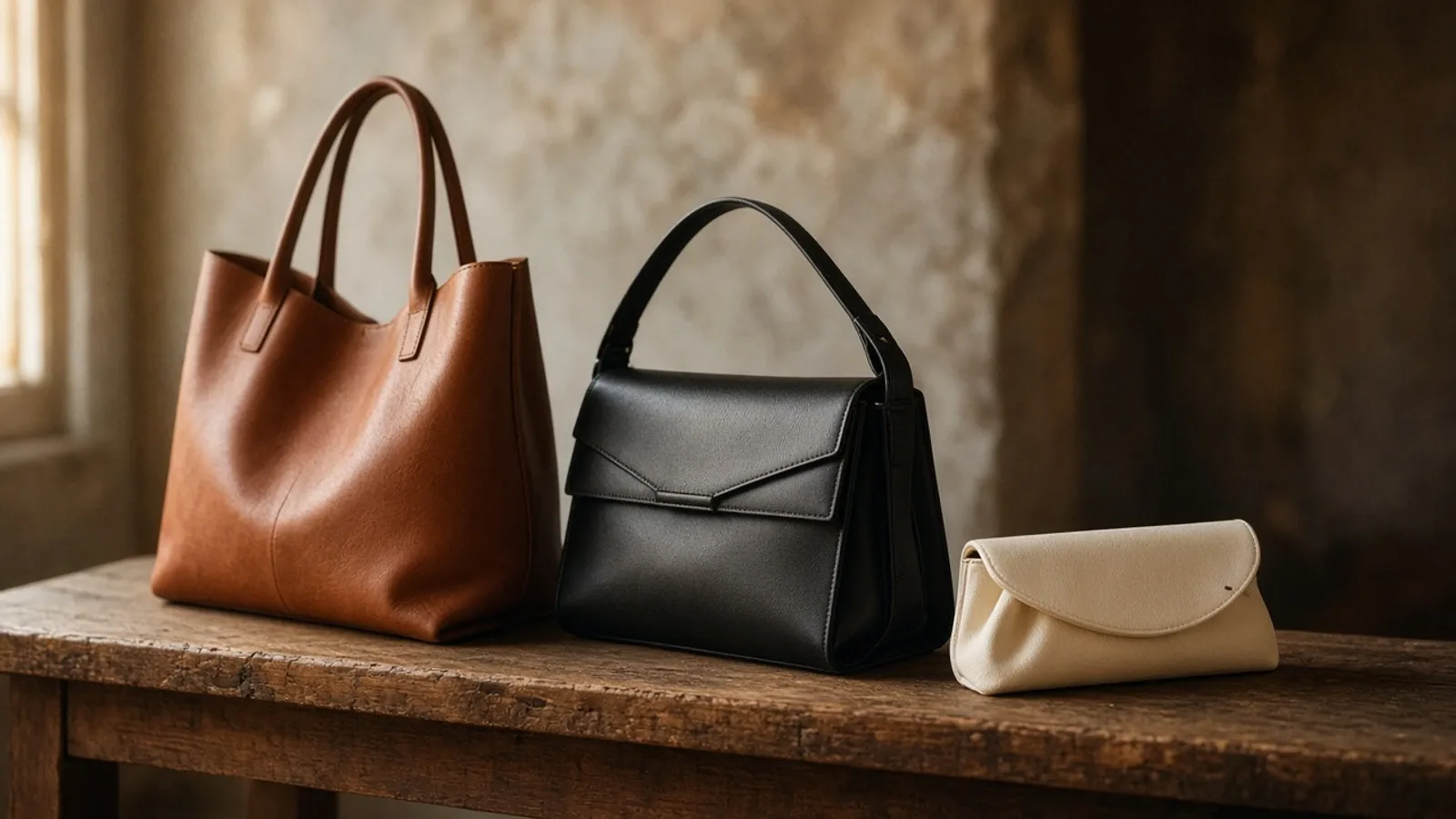
Most bag collections are not a collection. They are a set of unresolved category decisions. One bag is too small for work, one is too formal for the weekend, one is the right size but the wrong color, and the tote that fits everything is too heavy to carry.
The fix is not another bag. It is deciding the three jobs first, then buying one bag for each. Three bags cover almost every day: everyday, shoulder, and evening.
The three jobs
1. The everyday bag
This is the bag that goes to work, to appointments, and on the train. It needs to hold your actual daily carry: laptop or tablet, notebook, water bottle, pouch, keys, phone.
- Size: measured, not guessed. Put your daily items on the table and measure the pile.
- Shape: a structured tote or a large shoulder bag with a wide opening.
- Strap: a shoulder strap that stays up, and a top handle if you carry it by hand.
- Weight: empty weight matters. A beautiful bag that is heavy before you put anything in it will stay home.
2. The shoulder bag
This is the bag for weekends, dinners, errands, and days when you do not need the laptop. It should hold a phone, a small wallet, keys, a lipstick, and a compact.
- Size: big enough for the essentials, small enough to sit under your arm.
- Strap: adjustable, so it works over a coat and under a jacket.
- Closure: a zip or a secure flap. An open tote is not a shoulder bag.
3. The evening bag
This is the bag for weddings, dinners, and anything that requires a dress. It does not need to hold your life. It needs to hold a phone, a card, a key, and a lipstick.
- Size: small, but not so small that the phone does not fit. Test it.
- Strap: a thin chain or a clutch strap that can be tucked inside.
- Color: your accent, or a metallic that matches your jewelry.
The color rule
| Bag | Colour role | Where the money goes |
|---|---|---|
| Everyday | Your darkest neutral, or the neutral that matches your coats | Most of the budget: strap, lining, and hardware fail first |
| Shoulder | Your second neutral or a deep accent | Mid: construction over logos |
| Evening | Your accent, or a metal that matches your jewellery | Least: fewest wears, so a mid-price bag is enough |
| Gym or laptop backpack | Not part of the rotation | A separate functional purchase, budgeted as gear |
Three bags do not need three colors. They need a system.
- Everyday bag: your darkest neutral, or the neutral that matches your coats. This is the bag that gets the most wear, so it should work with everything.
- Shoulder bag: your second neutral, or a deep accent that works with your palette.
- Evening bag: your accent or metal. This is where you can be less practical.
The hardware should match your season’s metal. A gold-clasp bag with silver jewelry is a small dissonance that shows up in photographs. If you mix metals deliberately, do it consistently.
If you do not know your palette, the neutral roles guide and the free color analysis quiz are the starting points. The workweek capsule and the carry-on capsule use the same color logic for clothes.
What to spend on
- Spend on the everyday bag. It gets the most wear, carries the most weight, and is the one most likely to fail at the strap, lining, or hardware. The cost-per-wear math justifies a higher price here.
- Spend on construction, not logos. Check the stitching, the lining, the zipper, and the strap attachment. A bag with a weak strap is not a bargain.
- Save on the evening bag. It gets the fewest wears. A well-made mid-price bag is enough.
- Do not spend on a fourth category. If you need a gym bag or a laptop backpack, that is a separate functional purchase, not a fashion rotation.
The 30-wear rule is the filter: will you carry it thirty times? If not, it is an occasion bag, and it should be budgeted like one.
The pouch system
The rotation only works if switching bags is fast. The trick is not fewer things; it is a transferable core.
- One small pouch holds the essentials: cards, lipstick, keys, a pen.
- One tech pouch holds the charger, cable, and earbuds.
- One bag organizer gives the tote structure and lets you move the core from bag to bag.
When you switch bags, you move two pouches, not twenty loose items. That is the difference between a rotation and a chore.
Care and storage
- Stuff the bag with tissue or a shaper when stored, so it keeps its shape.
- Store it in a dust bag, not a plastic bin, so the leather can breathe.
- Condition leather once or twice a year, depending on the finish.
- Fix the strap or lining early. A small repair is cheaper than a replacement, and it keeps the bag in the rotation.
The environmental logic is the same as the rest of the wardrobe: fewer, better, worn longer. The Ellen MacArthur Foundation’s textiles work documents why keeping products in use is one of the most effective interventions available to a consumer.
Who this is not for
If you love bags and collecting is part of the pleasure, this is not a rule you have to follow. If you carry a laptop, a pump, or medical equipment, your everyday bag is a functional purchase first; choose the one that carries the load.
And if one bag genuinely does everything for you, you do not need three. The goal is a decision you can trust, not a collection you have to maintain.
Method and limits
This rotation is derived from the CiciTrends wardrobe math and color system. It assumes a mix of work, weekend, and occasional evening use, and a temperate climate. It is a template, not a rule; adjust the sizes and colors to your actual carry and your palette.
Direct answers
Frequently asked questions
What three handbags actually cover everyday life?
An everyday bag for work and appointments, a shoulder bag for weekends and errands, and a small evening bag for weddings and dinners. Decide those three jobs before you buy anything. Three bags chosen for measured jobs cover almost every day, which is why a fourth fashion bag rarely earns its space.
How do I choose the right size everyday bag?
Put your daily carry on a table and measure the pile: laptop or tablet, notebook, water bottle, pouch, keys, phone. Then check the empty weight, because a bag that is heavy before you fill it stays home. A wide opening and a strap that stays up matter as much as capacity.
Should all three bags be the same colour?
No, they need a system rather than a single colour. Use your darkest neutral, or the neutral that matches your coats, for the everyday bag, a second neutral or deep accent for the shoulder bag, and your accent or a metal for the evening bag. Match the hardware to your season's metal.
Where should I spend the most on a handbag?
On the everyday bag. It gets the most wear, carries the most weight, and is the one most likely to fail at the strap, lining, or hardware. Check construction before logos. Save on the evening bag, which gets the fewest wears, and apply the thirty-wear rule to anything outside the three.
About the author

The editorial voice of CiciTrends. Color, fit, and the small decisions that make a wardrobe work. Written by an AI-assisted desk under human direction.
Reporting, sourcing and AI disclosure:/editorial-standards/
Keep reading
Related stories

Fashion grief: when clothes hold a life you have left
A silk blouse, a wedding suit, a pre-baby dress. Why clothes hold memory, and a keep/repurpose/release framework that does not require a purge.
Jan 3, 2026
The three-shoe rotation: fewer pairs, more wear
An everyday pair, a weather pair, and a smart pair cover most of the week. The fit rules, the rotation, and when to replace them.
Jan 3, 2026
The 8 neutrals every palette needs
All 60 neutrals in the Color System were counted. Only two colors repeat in five seasons. The eight neutral roles worth buying, and the black almost nobody should own.
Nov 4, 2026