Visible mending: make the repair part of the piece
In short
Sashiko, decorative darning, and creative patching turn damage into a design decision. A beginner's guide to the techniques, the kit, and the first project.
- Start with a hole the size of a coin in a garment you are not afraid to ruin, use contrasting thread, and stop while the repair is still fun.
- Match the repair to the damage: a coin-sized hole takes decorative darning, a large hole or thin area takes a patch behind it, and structural damage takes a seam fix first.
- Keep the tension loose rather than tight on sashiko, because tight stitches pucker the fabric, and a wobbly line simply reads as handmade.
- Do not use regular sewing thread on heavy denim, do not sew a patch onto dirty fabric, and put a patch or grid behind every hole before stitching.
By Cici
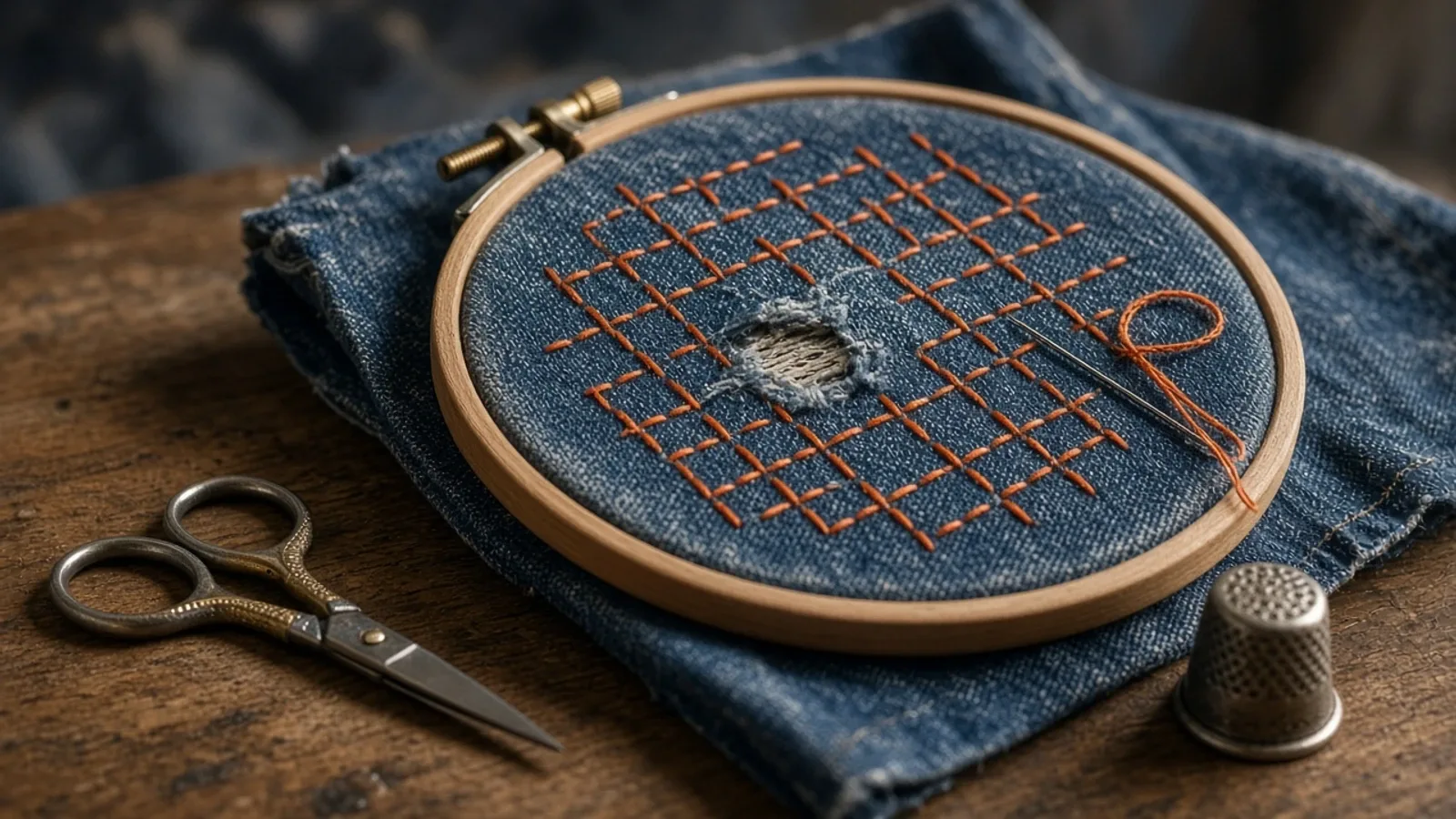
Hold a moth-nibbled jumper up to the window and you have a choice. Invisible mending tries to make the repair disappear. Visible mending does the opposite: it makes the repair part of the piece, so the damage becomes a design decision instead of a secret.
Both are legitimate. The choice depends on the garment, the damage, and what you want the repair to say. A useful test: if you would happily wear the repair on a Saturday, mend it visibly. If you would not, practise on something else first.
| Damage | Technique | What it needs |
|---|---|---|
| Small hole in knitwear | Decorative darning | A support grid, contrasting thread, and a darning mushroom inside the garment |
| Large hole or thin area | Creative patching | A sturdy patch behind the hole, edge stitches, and decorative stitches on top |
| Worn area on indigo denim | Sashiko | A long needle, thick thread, a chalk pattern, and tension kept loose |
| Failing seam or rotten lining | Structural repair first | The seam or lining fixed before any decorative stitching |
| Frayed edge on a tote or shirt | Patch or blanket stitch | The garment washed and dried, then pinned before stitching |
Why visible mending works
- It is honest. The repair does not pretend the damage never happened.
- It is durable. A visible patch can be stronger than a delicate invisible reweave.
- It is expressive. Color, thread, and pattern become part of the garment.
- It extends life. A piece that would have been discarded becomes wearable again.
The sustainability argument is simple: keeping a garment in use is one of the most effective ways to reduce its impact. The Ellen MacArthur Foundation’s textiles work makes the case at scale; visible mending is the individual version.
The proof is in your hand rather than in a photograph. Run a thumb across a well-worked darn and the surface feels flat, dense, and slightly stiff. A bad one puckers at the edges and pulls the garment out of shape the moment you move. That is the standard to aim for, and it is reachable in an evening.
Sashiko
Sashiko is a Japanese running-stitch technique. Traditional sashiko uses white thread on indigo fabric, often in repeating geometric patterns, to reinforce worn areas.
You do not need to be traditional to use it. The basic stitch is a running stitch:
- Mark the pattern with chalk or a washable marker.
- Use a long needle and thick thread — sashiko thread or embroidery floss.
- Take several small stitches at once, then pull through.
- Keep the tension even. Loose is better than tight; tight stitches pucker the fabric.
Sashiko is forgiving. A wobbly line reads as handmade, not failed. Sit near a window with the cloth flat across your knee, because the light shows the weave and your tension settles once you stop watching the needle.
Decorative darning
Darning is a woven patch over a hole. Traditional darning tries to match the fabric; decorative darning uses contrast.
- Build a support grid over the hole with long threads.
- Weave under and over the grid with a contrasting thread.
- Cover the hole and extend beyond it onto sound fabric.
- Press the repair gently.
On knitwear, a darning mushroom or a rounded object inside the garment keeps the shape.
Creative patching
A patch is the right answer for a large hole or a thin area.
- Use a sturdy fabric — denim, canvas, linen, or a contrasting cotton.
- Put the patch behind the hole and pin it.
- Stitch around the edge with a running stitch, backstitch, or blanket stitch.
- Add decorative stitches across the patch if you want.
A patch can be visible, intentional, and neat. It does not need to look like a scout badge.
The kit
- Needles — a sturdy embroidery or darning needle.
- Thread — sashiko thread, embroidery floss, or strong cotton.
- Scissors — small, sharp.
- Thimble — for denim and heavy canvas.
- Darning mushroom — for knitwear.
- Chalk or washable marker.
- Patch fabric.
- A seam ripper — for removing a bad repair.
You do not need a sewing machine. Most visible mending is handwork.
The first project
- Choose a garment you are not afraid to ruin. A pair of jeans, a plain tote, a wool sock.
- Start small. A hole the size of a coin is enough.
- Pick a contrasting thread. The contrast is the point.
- Stitch slowly. Even tension matters more than speed.
- Stop while it is still fun. A small finished repair beats a large unfinished one.
Do the first one on a Sunday afternoon, not at 11pm on a Tuesday when you want the jacket for Thursday. Rushing shows in the tension, and a repair done in a hurry is the one you end up unpicking while the kettle boils.
The invisible mending guide covers the other approach, including when a professional is the better call.
Where it fits in a wardrobe
Visible mending is maintenance, not a shopping strategy. It works best on pieces you already wear and want to keep: the capsule you actually rotate, the jacket you reach for, the jeans that fit.
It is also a useful filter for new purchases. If a garment is too delicate to repair, it is probably not a workhorse. The 30-wear rule and the repair question belong in the same decision.
What not to do
- Do not sew a patch onto dirty fabric. Wash and dry first.
- Do not use regular sewing thread on heavy denim. It will break.
- Do not pull the stitches tight. The fabric will pucker.
- Do not cover a hole without support. Put a patch or a grid behind it.
- Do not expect the first one to be perfect. The second is better.
Who this is not for
If the garment is formal, delicate, or valuable, practice on something else first. If the damage is structural — a failing seam, a rotten lining — start with a repair, not decoration.
And if you hate handwork, visible mending is not a moral obligation. Repair is one option; replacement, resale, and recycling are others.
Method and limits
This is a craft guide derived from the CiciTrends wardrobe and repair principles. The sustainability context is supported by the Ellen MacArthur Foundation’s textiles work. Techniques vary by tradition and fabric; practice on a scrap first.
Sources
- Ellen MacArthur Foundation. A New Textiles Economy.
Direct answers
Frequently asked questions
What is visible mending?
Visible mending is repair that treats the patch, stitch, or darn as part of the design rather than hiding it. It includes sashiko, decorative darning, and creative patching.
Do I need special tools for visible mending?
No. A needle, thread or embroidery floss, scissors, and a patch fabric are enough to start. A thimble and a darning mushroom help with heavier fabrics.
What is the difference between visible and invisible mending?
Invisible mending tries to blend the repair into the original fabric. Visible mending makes the repair a feature. The right choice depends on the garment and what you want the repair to say.
Can visible mending fix a large hole?
Yes, with a patch. A large hole needs a patch behind it, plus stitches to hold the patch and the damaged area together. The patch becomes part of the design.
Is visible mending only for denim?
No. Visible mending works on knitwear, shirts, jackets, canvas, and home textiles, not just denim. Denim is simply the most popular place to start because it is sturdy enough to take a patch and the contrast stitches show clearly against indigo. Start with the garment you already wear most.
About the author

The editorial voice of CiciTrends. Color, fit, and the small decisions that make a wardrobe work. Written by an AI-assisted desk under human direction.
Reporting, sourcing and AI disclosure:/editorial-standards/
Keep reading
Related stories
Invisible mending: what it can and cannot fix
Reweaving a moth hole is not the same as fixing a felted jumper. What invisible mending can repair, what it cannot, and when the math favors repair.
Dec 31, 2025

The Cost-Per-Wear Audit: What Your Wardrobe Actually Costs
A cost-per-wear audit turns a closet full of maybes into a decision. The formula, the thresholds, and the one number most shoppers never calculate.
Dec 30, 2025

The 30-wear rule: the shopping filter that survives a sale
Will you actually wear it thirty times? The rule, the math, the five questions to ask before you buy, and the exceptions worth making.
Dec 31, 2025