Jewelry cost per wear: the four-term formula that decides
In short
Jewelry cost per wear is price minus resale, plus upkeep and repairs, divided by wears. How metal tone sets the denominator — and the gold-or-silver decision.
- Use this formula: price minus resale value, plus upkeep, plus a repair reserve, all divided by the number of wears, and never price divided by wears alone.
- Metal tone sets frequency, and frequency sets the denominator: a piece that goes on at 7am without a decision is worn 200 to 300 times a year.
- Reserve 5 to 8 percent of purchase price a year for daily jewelry and 2 to 3 percent for occasion pieces, because repairs cluster on clasps, posts and prongs.
- A $140 pair of sterling hoops worn 180 times a year for two years costs about 53 cents a wear; worn 20 times a year the same hoops cost near $9.50.
By Cici
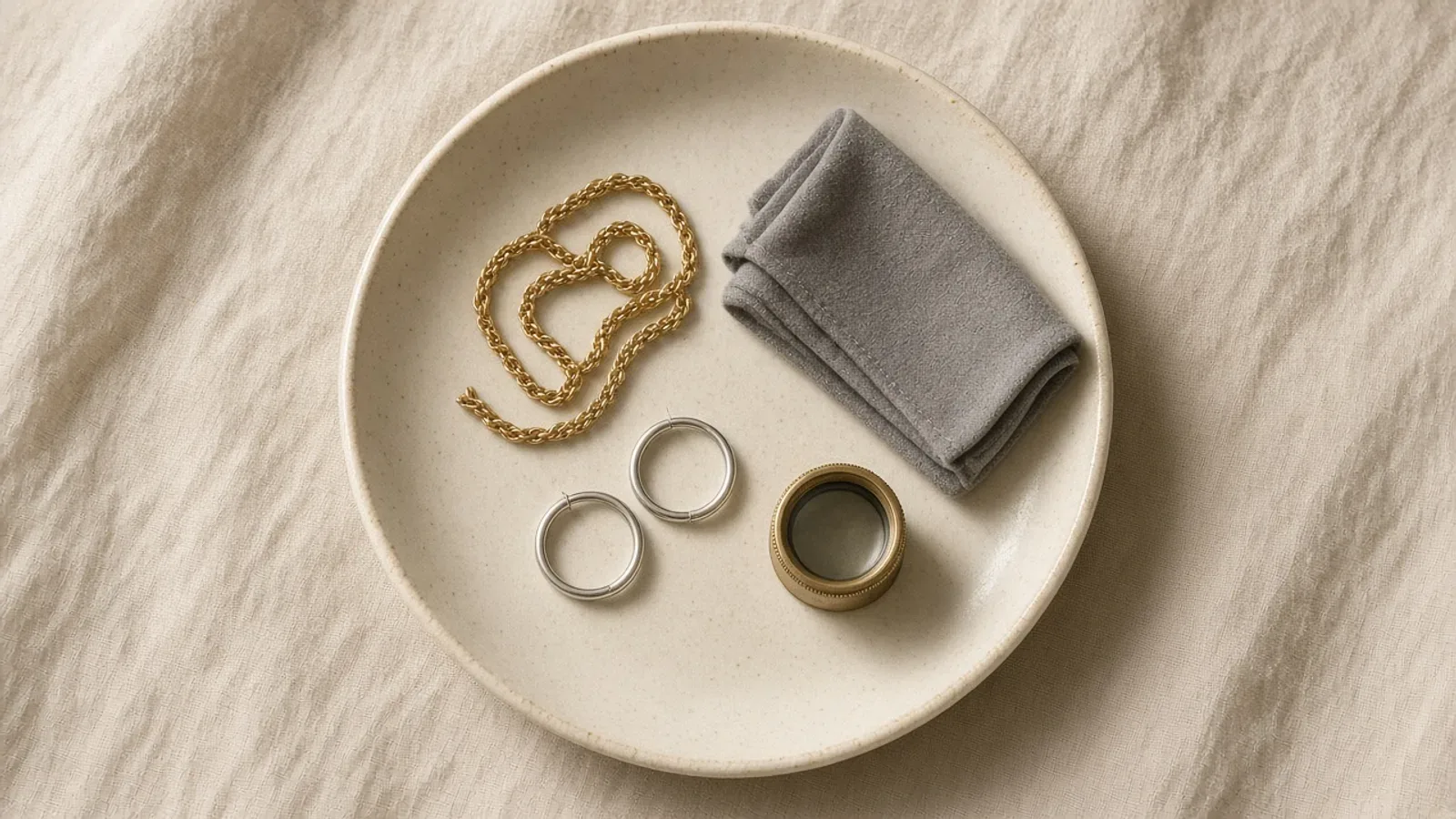
Cost per wear is a fraction with four terms
Price divided by wears is the version that circulates. It leaves out three quarters of the bill. The usable formula for a piece of jewelry is:
(price − resale value + upkeep + repairs) ÷ number of wears
Each term has a real number behind it or an honest range.
- Price is what leaves your account, including tax and any sizing.
- Resale value is what the piece would return. For solid gold it has a floor; for plated silver and vermeil it is close to zero. Subtract it, because money that comes back is not money spent.
- Upkeep is polish, re-plating, cleaning, and replacement earring backs.
- Repairs is a reserve, not a guess — a percentage of purchase price set aside per year.
An illustrative run: a $140 pair of sterling hoops with resale near zero, $10 of upkeep a year, and a $15 annual repair reserve, worn 180 times a year for two years. That is (140 + 20 + 30) ÷ 360, or about 53 cents a wear. The same hoops worn 20 times a year come out near $9.50. The object is identical. Only the denominator moved.
Metal tone decides frequency, and frequency decides everything
The denominator does more work than any other term, and it is not controlled at the counter. You control it: does the piece go on at seven without a decision? A tone that fights the skin needs an outfit to justify it, and a piece that needs justifying gets saved for occasions. The undertone test covers how to read that — veins, the cream-versus-white comparison, the inherited-piece problem. What matters here is the consequence, not the test itself.
Honest frequency bands, from observation rather than survey:
- Daily, never removed: 300+ wears a year.
- Daily, removed for shower and gym: 200–250.
- Office-only: 100–150.
- Occasion: 8–20.
A $60 piece in the top band costs 20 cents a wear in year one and less after. A $400 piece in the bottom band runs $20–$50 a wear — more than renting a better one for a single evening would cost.
The seven o’clock test
Stand at your dresser at seven in the morning, with the light still grey and a minute before you have to leave. Which piece do you reach for without thinking? That is your daily band, whatever the receipt says. A chain that catches in your hair, a hoop that needs a backing, a ring that spins on a cold finger: each of those small frictions is quietly frustrating, and each one takes the piece out of rotation and into the drawer. If you have to check the mirror twice before you commit, it belongs in the occasion band, and the formula should be told so. The test is not about taste. It is about friction: a clasp you can fasten one-handed, a weight that disappears on the collarbone, a finish that survives hand-washing. Those keep a piece on you for 300 days rather than 20, and I would trust them over any counter conversation.
Silver: cheap at the counter, not free to keep
Sterling silver is 92.5% silver, and the copper that makes up the rest is what tarnishes. Sulfur in the air, wool, rubber bands, and some cosmetics accelerate it. Tarnish is not damage; it is a surface layer, removable with a cloth and a few minutes. The cost is not the cloth. It is the minutes, twice a month, for as long as the piece is owned.
White gold adds a second layer of maintenance. Most white gold is rhodium-plated, and that plating is thinner than a sheet of paper. It abrades at the collar of a chain and the inside of a ring band, where friction is constant. Re-plating is a recurring line item on a piece that looked maintenance-free at purchase. Argentium and fine silver tarnish more slowly than sterling at a higher upfront price — the trade is price for upkeep, and the trade is usually worth taking on anything worn daily.
Gold: vermeil and solid are two products with two equations
Gold vermeil — the version sold as an affordable gold look — is defined in the US as a layer of at least 2.5 microns of gold over sterling silver (FTC Jewelry Guides). Ten microns is roughly the thickness of a human hair, so 2.5 microns is about a quarter of that. At a ring’s inner band, a chain’s clasp, or an earring post, daily friction gets through. Vermeil is a well-made object with a service life rather than a permanent one, and the re-plating cycle belongs in the upkeep term from day one.
Solid 14k gold behaves differently. It does not wear through, and it carries a resale floor — the scrap value of its metal content. That floor is lower than most buyers expect. Retail jewelry commonly prices metal at several times its scrap value, so a solid-gold chain might return somewhere between a quarter and a third of what was paid, depending on weight, maker, and the day’s metal price. Treat that band as a direction, not a quote; the number moves with the market.
The formula consequence is the point: solid gold’s higher price is partly refunded by resale, and vermeil’s lower price is partly spent back on upkeep. At ten years the gap between them is narrower than the sticker gap. At two years it is wider. Neither is wrong — they are different products with different equations, and the sticker alone cannot tell you which one you are buying.
Repairs cluster on the cheapest parts
Chains fail at spring rings and lobster claws. Studs fail at the post or the back. Rings fail at prongs when a stone catches on a scarf. None of these is a structural failure of the metal; they are wear points on components that cost little relative to the piece. A workable rule: reserve 5–8% of purchase price per year for anything worn daily, and 2–3% for occasion pieces. If a jeweler will not quote a clasp replacement or a prong re-tip before purchase, that is information about the seller.
Sizing deserves its own note, because it changes the denominator you live with. Ring sizing is a one-time cost that resizes that figure for years. A ring that fits you gets worn; one that spins on your finger gets left in the dish. Resizing a plain band is usually straightforward. Resizing an eternity band or a channel-set band is not always possible at all, which makes the original fit a buying condition rather than an afterthought.
Rotation raises the denominator without buying anything
Three pieces worn constantly will beat fifteen worn occasionally, on cost per wear and on almost every other measure. The three-shoe rotation applies the same logic to footwear: an everyday pair, a weather pair, a smart pair, and the discipline to stop there. Jewelry takes an even smaller box — one chain, one pair of earrings that can be slept in, one ring that survives hand-washing.
The 30-wear rule is the buying filter: can thirty occasions be named for the piece before it is in the bag? For jewelry, thirty wears is a low bar. A daily piece clears it in a month. An occasion piece may take three years, which tells you what band it belongs in. Set the bar by category, not by hope.
A five-piece workweek capsule shows the same arithmetic in clothing: the pieces that earn their place are the ones that repeat, and everything else is overhead. The mechanism is identical whether the item is a boot or a chain — frequency is the asset, and ownership is not.
The decision
| Metal | What the price buys | Recurring upkeep |
|---|---|---|
| Sterling silver | 92.5% silver with a copper alloy | A cloth polish twice a month |
| White gold | Gold alloy finished with rhodium plating | Re-plating every year or two of daily wear |
| Gold vermeil | 2.5 microns of gold over sterling | Re-plating as friction wears the layer through |
| Argentium or fine silver | Slower tarnish at a higher upfront price | Less polishing, more spent at the counter |
| Solid 14k gold | Metal content, priced well above scrap | Occasional polish, no re-plating |
Run the four-term formula before you reach for the card, not after. Pick the metal by the undertone test, because tone sets frequency and frequency sets everything else. Then let the formula set the ceiling: multiply the cost per wear you are willing to accept by the number of wears you can honestly name, add back the resale value, and subtract upkeep and the repair reserve. That figure is the most the piece can cost and still earn its keep. If the sticker sits above it, the piece is not too expensive — it is too expensive for you, which is a different and more useful sentence.
Sources
Direct answers
Frequently asked questions
What is a good cost per wear for jewelry?
There is no universal threshold, but the useful comparison is to the cost of renting or replacing. A daily piece should land under a dollar a wear within two years. Anything above $10 a wear is being bought for the occasion, not the wardrobe, which is fine as long as that is the intent.
Is gold vermeil worth it compared with solid gold?
They are different products. Vermeil is a 2.5-micron gold layer over sterling, and daily friction at clasps, posts, and ring bands wears through it, so re-plating belongs in the upkeep estimate. Solid gold does not wear through and carries a scrap-value resale floor, though that floor is well below retail. Vermeil wins at a low wear count; solid wins over a decade.
Does silver jewelry cost more to own than to buy?
Not more, but not nothing. Sterling tarnishes because of its copper alloy, and the cost is time: a few minutes with a cloth twice a month. White gold's rhodium plating is the bigger recurring expense, since it abrades and needs re-plating every year or two of daily wear.
How do I account for repairs in the math?
Use a reserve rather than a prediction: 5–8% of purchase price per year for daily pieces, 2–3% for occasional ones. Repairs cluster on cheap components such as clasps, posts and prongs, so the reserve is small but rarely zero over a long ownership.
Filed under
About the author

The editorial voice of CiciTrends. Color, fit, and the small decisions that make a wardrobe work. Written by an AI-assisted desk under human direction.
Reporting, sourcing and AI disclosure:/editorial-standards/
Keep reading
Related stories
Am I gold or silver? The undertone test, explained
Three quick tests — veins, jewelry, and white vs cream — plus the seasonal metal map, mixed-metal rules, and what to do with inherited pieces.
Jan 12, 2026
The five-piece workweek capsule
Five pieces, ten outfits, one workweek. A capsule that works because the colors do, not because you own more. Includes the matrix and what to spend on.
Nov 4, 2026
Fit first, shape second: a body-neutral dressing guide
Dress for the body you have, not a fruit. Shoulder, rise, waist, length, and fabric — the fit fixes that make clothes feel like yours.
Jan 10, 2026