Microbiome-friendly skincare: what actually helps
In short
The skin microbiome is real. The marketing is ahead of the evidence. What disrupts it, what supports it, and why gentle cleansing beats a probiotic serum.
- The 2026 review of cosmetic interventions for the skin microbiome rates the evidence preliminary, so a probiotic serum is an experiment rather than the foundation of a routine.
- Cleanse once or twice a day with a fragrance-free formula, moisturize with ceramides or glycerin, wear sunscreen, and skip scrubs: that combination has better evidence than any microbiome-specific ingredient.
- Give a new microbiome-friendly product four weeks before judging it, change one product at a time, and never stack two experiments in the same fortnight.
By Cici
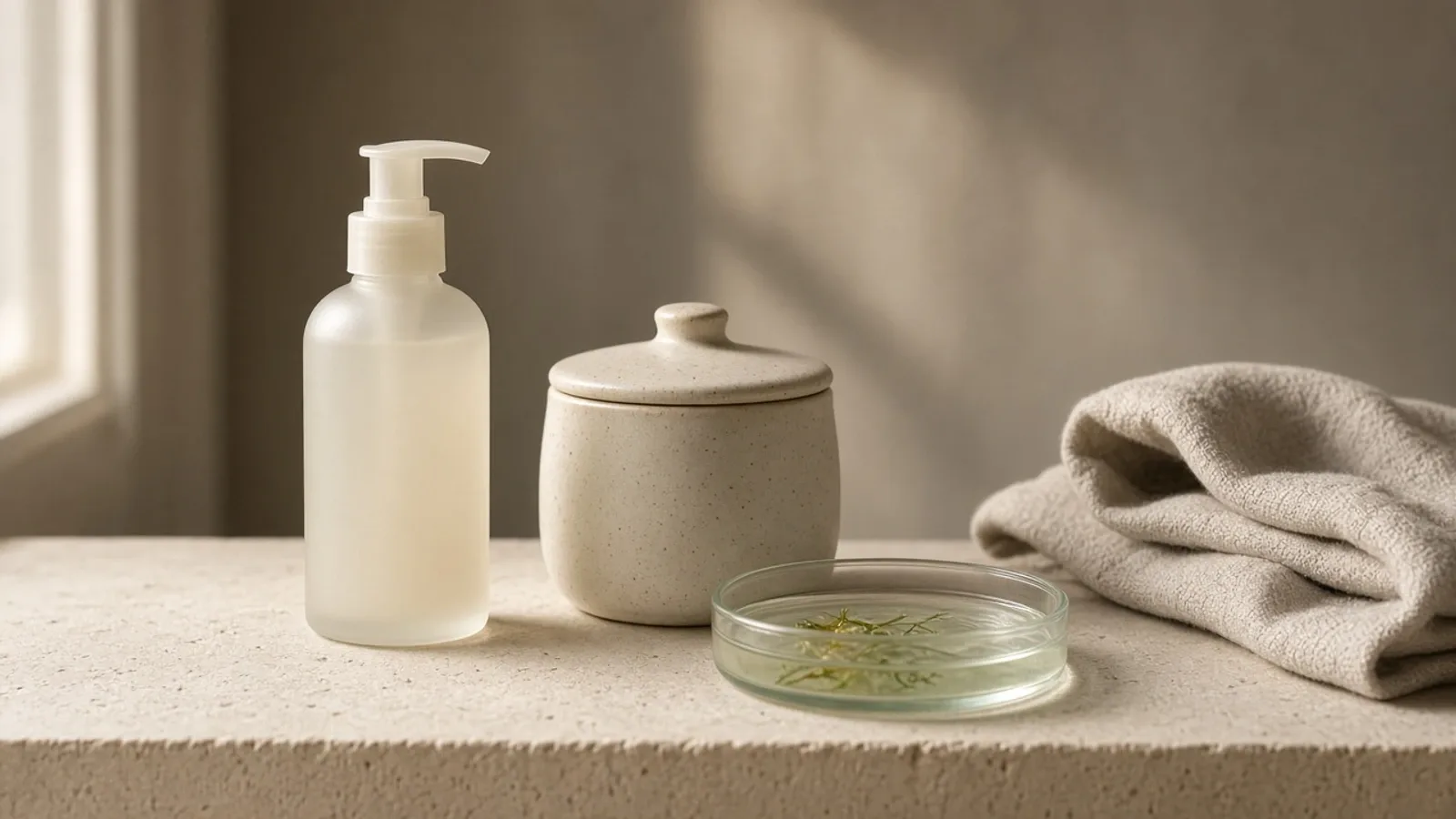
The skin microbiome is real. The skin is covered in bacteria, fungi, viruses, and mites, and that community interacts with the barrier and the immune system. What is not real — or at least not established — is most of the “microbiome-friendly” marketing built on top of it.
A 2026 review of cosmetic interventions for the skin microbiome puts it plainly: the evidence for microbiome-targeted cosmetics is preliminary. The science is promising. The shelf is ahead of it.
What the microbiome is
The skin microbiome is the collection of microorganisms that live on the skin. It varies by body site — the face, scalp, armpit, and foot have different communities — and it changes with age, hormones, hygiene, medication, and skin disease.
The microbiome is not a simple “good bacteria vs bad bacteria” story. Diversity and balance matter more than a single strain. That is why “kill all the bacteria” is the wrong goal, and why “add one probiotic strain” is not automatically the fix.
What disrupts it
- Harsh cleansing and over-cleansing. Stripping the skin barrier changes the environment the microbiome lives in.
- Over-exfoliation. Acids and scrubs can damage the barrier and increase sensitivity.
- Antibiotics. Oral or topical antibiotics can disturb the community; they are sometimes necessary, but they are not a skincare step.
- Fragrance and irritants. They can trigger inflammation, which changes the skin environment.
- Skin disease. Eczema, acne, and rosacea are associated with dysbiosis; the disease and the microbiome affect each other.
What “microbiome-friendly” means
In practice, the label usually means one of three things:
- The product avoids harsh surfactants, low pH, or fragrance.
- The product contains prebiotics, probiotics, or postbiotics.
- The product claims not to disturb the microbiome.
The first is reasonable and often overlaps with “gentle.” The second is where the evidence is thinnest. The third is a marketing claim that is hard to verify.
The 2026 review describes the category as promising but not proven, with a need for better clinical trials and standardized ingredients. That is not a reason to avoid every product; it is a reason to be skeptical of the premium.
What actually helps
- Cleanse gently. Once or twice a day, fragrance-free, no scrubbing.
- Moisturize. A barrier-supporting moisturizer with ceramides or glycerin helps the environment the microbiome lives in.
- Wear sunscreen. UV damages the barrier and the skin.
- Do not over-exfoliate. If your skin stings, stop.
- Treat skin disease with a clinician. Acne, eczema, and rosacea need a diagnosis, not a probiotic.
The barrier reset is the practical version of this advice. The skincare conflicts guide covers what not to layer.
A minimal microbiome-friendly routine
| Step or claim | The evidence position | Verdict |
|---|---|---|
| Gentle fragrance-free cleanser, once or twice a day | The best supported step in the routine | Keep |
| Barrier moisturizer with ceramides or glycerin | Supports the environment the community lives in | Keep |
| Daily sunscreen | UV damages the barrier and the skin | Keep |
| Probiotic serum with a CFU count | Early evidence, unstandardized strains, claims outrun the data | Experiment, not a foundation |
| “Microbiome-balancing” toner | Usually a gentle hydrator at a premium price | Skip |
You do not need a dedicated microbiome product to support the skin ecosystem.
- Morning: rinse or a gentle cleanser, moisturizer, sunscreen.
- Evening: gentle cleanser, moisturizer. A retinoid two or three nights a week if you use one, not on the same night as an acid.
- Weekly: no scrub. Clean your tools and pillowcase. The body care routine applies the same logic below the neck.
- When something irritates: stop the new product, not the whole routine.
The routine is boring. That is the point: fewer variables means less disruption, and less disruption is the most reliable way to support the microbiome.
What to skip
- Probiotic serums with vague CFU counts. A CFU count on the label does not tell you whether the strain survives or whether it helps.
- “Microbiome-balancing” toners. Most are gentle hydrators with a premium price.
- Antibacterial everything. The goal is balance, not sterility.
- Supplements that promise clear skin. The evidence is not strong enough to make them a foundation.
The four-week test
Choose one product and give it four weeks. Wash your face as usual, pat it dry with a clean towel, and look at your cheeks in daylight rather than under the bathroom bulb before you apply anything. Note two things only: whether your skin stings when the moisturizer goes on, and whether the dry patch beside your nose has softened. Those two answers will tell you more than any badge on the box. If your skin is worse at week two, stop the new product rather than layering a rescue serum on top of it.
Who this is not for
If you have eczema, rosacea, acne, or a compromised immune system, a dermatologist’s plan comes first. The microbiome is part of the picture, but it is not a self-treatment.
If you love a microbiome-friendly product and it works for you, keep it. The point is not to avoid the category; it is to stop paying for certainty that does not exist yet.
The honest summary
The microbiome matters. The products are early. Gentle cleansing, moisturizing, sunscreen, and avoiding over-exfoliation are the evidence-backed basics. A probiotic serum is an experiment, not a foundation. If you try one, change one product at a time and give it four weeks before judging it. Do not stack experiments. That is enough. Simple is the strategy.
Sources
- Taléns-Visconti R, Diez-Sales O, Nácher A. Cosmetic Interventions for Skin Microbiome Modulation: Current Strategies and Future Directions. Skin Research and Technology, 2026.
- Farris PK, Campos V. Evidence-Based Alternative Strategies to Improve and Restore Skin Barrier Function: A Narrative Review. American Journal of Clinical Dermatology, 2026.
Direct answers
Frequently asked questions
What is the skin microbiome?
The skin microbiome is the community of bacteria, fungi, viruses, and other microorganisms that live on the skin. It interacts with the immune system and the skin barrier, and its balance is associated with conditions such as acne, eczema, and rosacea.
Do microbiome-friendly products work?
The evidence is preliminary. A 2026 review of cosmetic interventions for the skin microbiome describes the evidence as early and the category as promising but not proven. Gentle cleansing and barrier support have better evidence than most microbiome-specific ingredients.
Does cleansing damage the skin microbiome?
Harsh cleansing can strip the skin and disrupt the barrier, which in turn affects the microbiome. A gentle, fragrance-free cleanser once or twice a day is enough for most people; scrubbing and over-cleansing are the bigger problem.
Are probiotic skincare products worth it?
Some topical probiotics and postbiotics have early evidence, but the category is not standardized and the claims often outrun the data. If you want to try one, treat it as an experiment, not a foundation.
How do I support my skin microbiome?
Gentle cleansing once or twice a day, a barrier moisturizer, daily sunscreen and no over-exfoliation do more than most supplements. Avoid antibacterial everything, and do not use antibiotics on the skin unless a clinician prescribes them.
About the author

The editorial voice of CiciTrends. Color, fit, and the small decisions that make a wardrobe work. Written by an AI-assisted desk under human direction.
Reporting, sourcing and AI disclosure:/editorial-standards/
Keep reading
Related stories
How to reset your skin barrier (without stopping everything)
A barrier reset is not a week of doing nothing. It is removing the irritants, keeping the basics, and giving the skin time to recover.
Dec 30, 2025
The at-home manicure that actually lasts
Most DIY manicures chip because of prep, thin layers, and the tips. A ten-minute routine, the ten-day rules, and what to know about UV lamps.
Jan 3, 2026
Why your foundation turns orange
It is usually not your skin's pH. Research points to sebum, pigment load, and the wrong undertone. Here is the fix for warm, cool, olive, and neutral skin.
Nov 4, 2026