Why your foundation goes cakey in winter (the texture fix)
In short
Your base is not the problem and your shade has not changed. Why foundation goes cakey in winter, plus the texture and quantity fix that costs nothing.
- Halve the quantity before you change the bottle: one pump instead of two, pressed in two thin passes, because a July amount of base looks like a mask in a November room.
- Move one step richer in the formula and one step lighter in application: a hydrating fluid pressed with warm fingers or a damp sponge sits flat where a buffed mattifying base catches on flakes.
- Let moisturiser settle for five minutes before base goes on, since foundation pressed onto a tacky layer slides and separates by lunchtime and gets blamed on the formula.
By Cici
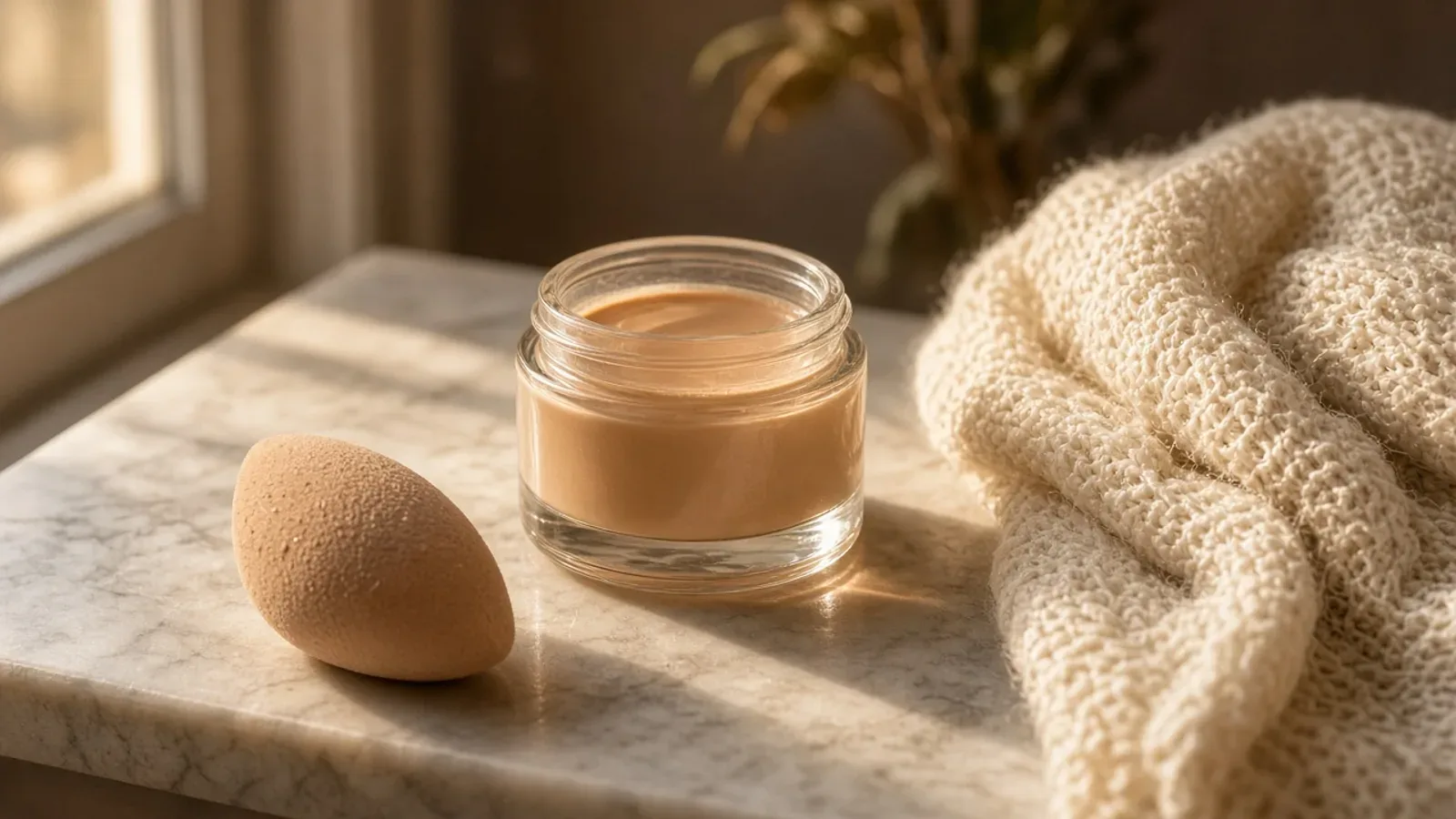
The November break: three things changed, and none of them is your undertone
It happens at 4:40 in the afternoon, in the bathroom mirror at work, under lights that are honest in a way your bathroom at home is not. The base you pressed on at 8am is no longer on your face. It is sitting on it, in a thin sheet, with a hairline crack running down each cheek.
Your first thought is that the formula changed. It did not. Neither did your undertone, and neither did the shade you have bought three times running. What changed is the room, the collar, and how many times a day you cross a threshold.
Indoor heating is the biggest of the three. Warm air holds more moisture than cold air, so a heated room pulls relative humidity down hard, and skin that was comfortable in September is now losing water to the air all day. The American Academy of Dermatology’s skin care basics put moisturising at the centre of dry-skin care for exactly this reason, and note that low humidity and hot water both work against you. The surface your base has to sit on is drier, slightly rougher and less pliable than it was six weeks ago.
Then the collar. Woolmark’s fibre guidance describes wool as absorbing moisture vapour from the air around it and buffering humidity swings, which is why a scarf can feel dry against your jaw while it is quietly doing its job. The useful part for you is mechanical: a scarf, a turtleneck and a coat collar all press and slide against the same two inches of jaw for eight hours. That is friction, and friction moves makeup.
Third, the transitions. Front door, car, lobby, lift, overheated office, cold street, warm restaurant. Every crossing is a small temperature and humidity event, and your base is the layer taking the hit.
The two-minute press test
| Where it fails | What the press shows | What to change |
|---|---|---|
| Jaw, under the scarf | A soft roll or smear of product | Less base on the two inches nearest the collar |
| Jaw, under the scarf | Flakes clinging to dry skin | One step richer: a hydrating, more fluid formula |
| Nose, an hour into a warm office | A shiny, separated translucent film | Stop mattifying skin that dry air is already dehydrating |
| Cheek, in the warmest room of the day | Texture you could trace with a fingernail | Water and a settled moisturiser underneath, not more coverage |
| Whole face by mid-afternoon | Pigment catching on flakes | Press with warm fingers or a damp sponge, never a buffing brush |
Stop looking at your face. Start pressing it. Looking tells you that something is wrong. Pressing tells you what.
Wash your hands, wait until you have been indoors for at least an hour, then press a clean fingertip flat against three places and lift straight up.
The jaw, right where the scarf sits. If the base lifts in a soft roll or a smear, you have too much product on a surface that is being rubbed all day. If it lifts as flakes clinging to dry skin, the formula is too dry for the room.
The nose, an hour into the warm office. If it has gone shiny and separated into a translucent film, you are fighting oil with a mattifying formula in air that is already dehydrating you. Two dry things do not cancel each other out.
The cheek, in the warmest room of your day. If the base has settled into a texture you could trace with a fingernail, the surface underneath needed water, not more coverage.
Three checks, three different fixes. Most people find they have two at once, which is why a single new product rarely solves it.
The texture rule: one step richer, one step lighter
The same formula cannot do September and November, and buying a new shade is the wrong answer to a texture question. A shade that was right in September is still right. Your undertone has not renegotiated itself because the radiator came on.
Move one step richer in the base and one step lighter in how you apply it. A hydrating, slightly more fluid formula pressed into the skin with warm fingers or a damp sponge will sit down flat, because pressing does not disturb the dry surface layer. A mattifying formula buffed on with a brush does the opposite: the bristles lift flakes off the surface and the pigment catches on them. That is the cakey look. It is not a coverage problem, it is a surface problem, and there is a particular small humiliation in catching your own reflection at 3pm and seeing texture you can count.
If you love your current bottle and do not want to replace it, get most of the way there by changing the layer underneath: a hydrating serum or a richer moisturiser, left to settle before base goes on. Five minutes is the whole trick. Base pressed onto moisturiser that is still tacky will slide and separate by lunchtime, and then you will blame the foundation again.
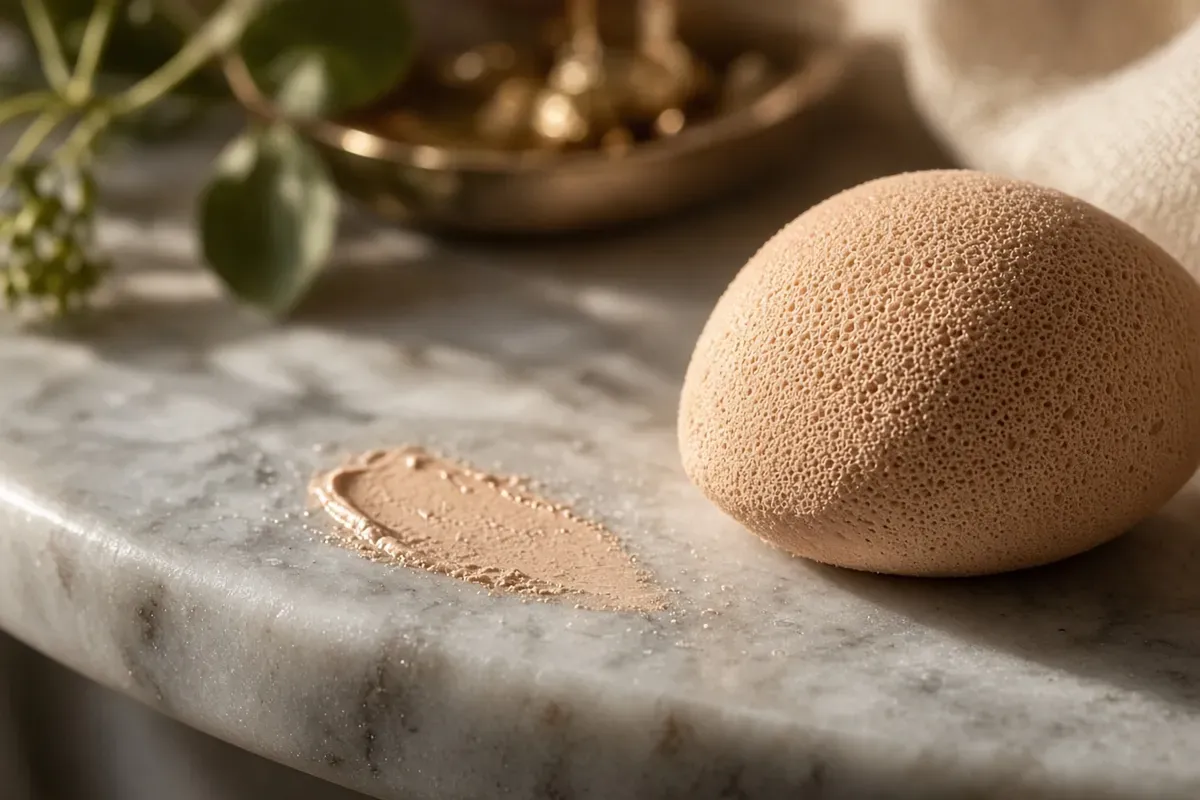
Press, then lift. The sponge tells you more than the mirror.
The quantity rule: half, applied twice
Here is the number that changes more faces than any product. Use half of what you used in July, and apply it in two passes.
One pump, not two. Press the first pass thinly over the whole face, let it settle for a minute while you do your eyebrows, then use what is left on your fingers for a second pass only where the redness or darkness actually lives: the corners of the nose, the chin, under the eyes. Two thin passes in dry air look like skin. One full pass looks like a mask that has been left out overnight.
You will know you have got it right when the second pass disappears. If you can still see the edge of where you pressed, you used too much in that spot.
The line you say to yourself at the mirror is usually “this formula has changed”. It has not. You are wearing a July quantity in a November room.
The collar, the party, and the one thing you don’t buy
Coverage placed exactly where a scarf, turtleneck or coat collar rubs is coverage that will transfer. So place it lower and sheerer. Take the base down the jawline with a barely damp sponge, stop short of the two inches directly under the ear, and let the collar do the framing. The same logic that governs a neckline governs a jawline: the edge you leave visible is doing more work than the coverage you add. If you are building a party outfit around a high neck or a big scarf, treat that neckline as the frame and keep the base quieter underneath it, which is the approach in the holiday party outfits by color season guide.
For the first cold-weather party, keep it boring. You are in someone’s hallway at 8:20 with your coat still on and the heating turned up to maximum, and this is not the night for a first experiment. Warm the base between your fingertips for a few seconds, press it on, then use cream colour on cheeks and lips and stop. Cream on cream blends into itself, which is why it survives a hot room better than powder layered over liquid. And do not introduce anything new within a week of an event. A first-time active or a first-time formula in December is how you end up with a reaction that has a date in the diary. If your skin is already reactive going into party season, spend the week before on barrier care rather than on a new primer, and use the version in the five-minute face that still looks like you while it settles.
One line for readers in warm or southern-hemisphere climates heading into humid early summer: the rule runs exactly in reverse. Go one step lighter and more water-based, powder only where skin creases, and treat base as a sheer layer rather than as coverage. Humidity is the same variable, pointed the other way.
What you do not need: a new shade, a new primer category, or a setting product you have never worn for a full day. If your base has turned orange rather than cakey, that is a different problem with a different cause, and why your foundation turns orange covers it. Cakey is a texture story.
Tonight, take your base off and look at the surface of your face rather than the colour of it. Tomorrow morning, halve the amount, press it in with your fingers, and put the brush down. That is the whole swap.
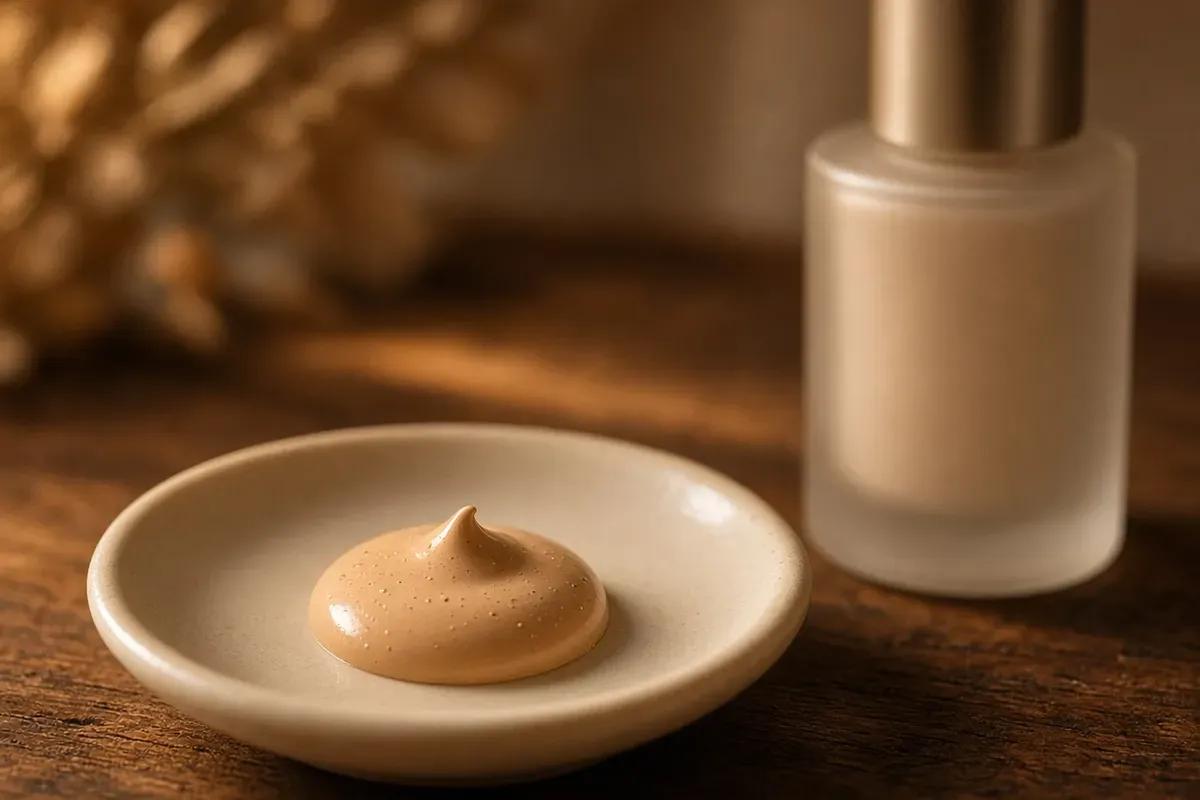
One pump, two thin passes.
Direct answers
Frequently asked questions
Why does my foundation suddenly look cakey in winter?
Because the room changed, not the formula. Heated indoor air holds far less moisture, so the skin your base sits on is drier and slightly rougher than it was in autumn, and a scarf or collar adds friction along the jaw. The result is pigment catching on dry surface rather than sitting flat.
Do I need a new foundation shade for winter?
Not for a texture problem. If your base goes patchy and cakey rather than grey or orange, your shade is fine. Change the texture of the formula and halve the quantity before you spend anything on colour.
How much foundation should I use in cold weather?
Half of your summer amount, applied in two thin passes. One pump pressed over the whole face, then a second pass only on the areas with redness or darkness. Two thin layers in dry air look like skin; one thick layer looks like a mask.
Why does makeup transfer onto my scarf and turtleneck?
Because coverage placed exactly where fabric rubs is coverage that moves. Keep the two inches along the jawline sheerer, stop short of the spot under the ear, and let the collar frame the face instead of pressing into a full-coverage edge.
Filed under
About the author

The editorial voice of CiciTrends. Color, fit, and the small decisions that make a wardrobe work. Written by an AI-assisted desk under human direction.
Reporting, sourcing and AI disclosure:/editorial-standards/
Keep reading
Related stories
The skincare ingredients that actually conflict
Most 'never mix' lists confuse irritation with chemistry. Here are the pairs that genuinely conflict, the myths worth dropping, and how to layer actives without fear.
Dec 31, 2025
PFAS in clean beauty: what actually changed in 2026
France banned PFAS in cosmetics. The FDA found 51 PFAS in 1,744 products and could not confirm most were safe. Here is what changed, and what 'clean' still does not mean.
Nov 4, 2026
Postpartum hair loss: what is normal and when it ends
The shedding is usually telogen effluvium, not permanent baldness. Why it happens, the timeline, what helps, and the signs that need a doctor.
Jan 8, 2026