Beyond retinol: what bakuchiol can and cannot do
In short
One randomized trial found bakuchiol comparable to retinol for photoageing, with less irritation. Here is what the evidence supports, and what it does not.
- The only direct comparison is a 2019 trial of 44 patients using 0.5% bakuchiol twice daily against 0.5% retinol once daily for 12 weeks, with comparable wrinkle and pigment results.
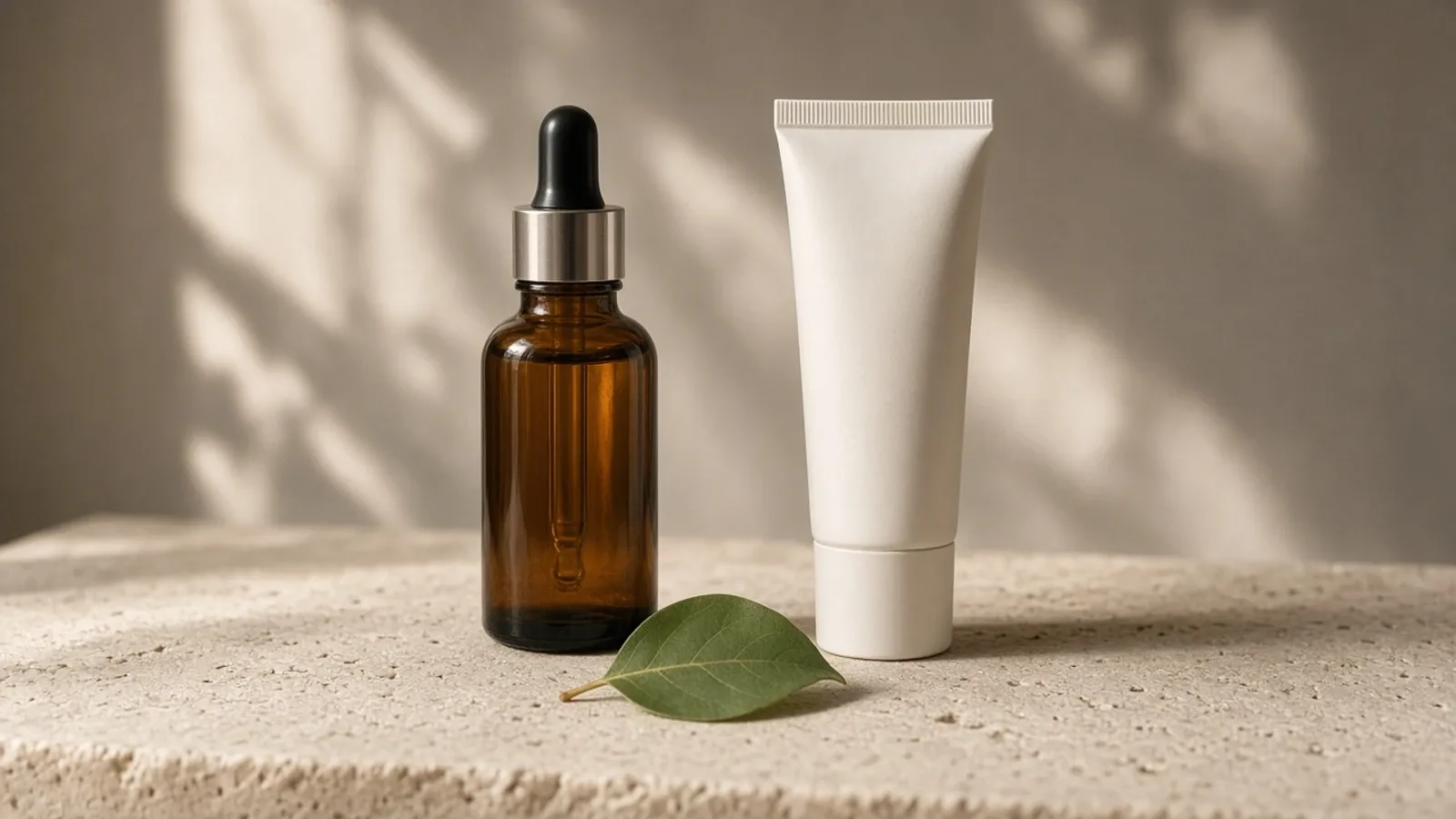
- Choose a bakuchiol product at or near 0.5% in an opaque, airless or dark package, since the ingredient is oil-soluble and sensitive to light and air; a clear jar is a poor sign.
- Bakuchiol is not retinol: it cannot replace prescription tretinoin, has no reliable pregnancy-safety evidence, and needs twelve weeks rather than twelve days before the result shows.
By Cici
Retinol has the best evidence of any over-the-counter anti-ageing ingredient, and the worst reputation for irritation. That combination is why “retinol alternatives” sell so well, and why most of the claims around them are ahead of the data.
Bakuchiol is the best-studied alternative. It has one randomized, double-blind trial comparing it directly with retinol, and the result is more interesting than either the marketing or the skepticism suggests.
What the trial actually found
The study, published in the British Journal of Dermatology in 2019, randomized 44 patients to either 0.5% bakuchiol cream twice daily or 0.5% retinol cream once daily for 12 weeks. Both groups improved wrinkle surface area and hyperpigmentation, with no statistically significant difference between them. The retinol group reported more facial scaling and stinging.
That is a meaningful result. It is also a small study, with one concentration, one formulation, and a short follow-up. It supports bakuchiol as a better-tolerated alternative with comparable results in the short term. It does not prove that bakuchiol is a permanent replacement for retinol, or that every bakuchiol product behaves like the one in the trial.
A 2024 systematic review of cosmeceuticals for anti-ageing included bakuchiol among the ingredients with clinical evidence, while noting that the overall quality of cosmeceutical research varies. That is the honest state of the field: promising, not settled.
Why retinol is still the benchmark
Retinol is a vitamin A derivative with decades of evidence behind it. It increases cell turnover, supports collagen production, and improves fine lines, texture, and pigmentation. It is also irritating, especially at the start, and it makes skin more sensitive to the sun.
The irritation is not a sign that it is working harder. It is a sign that the dose or frequency is too high for your skin. Most retinol advice is really about tolerance: start low, use it two or three nights a week, moisturize, and wear sunscreen.
Bakuchiol does not cause the same scaling and stinging in the trial, which is why it appeals to people who cannot tolerate retinol. But “gentler” is not the same as “more effective,” and “plant-based” is not the same as “safe for everyone.”
What bakuchiol can do
- Improve the appearance of fine lines and pigmentation over 12 weeks, at 0.5%, in the studied formulation.
- Cause less scaling and stinging than 0.5% retinol in the same trial.
- Fit a simple routine because it is generally used twice daily and does not carry the same sun-sensitivity warnings as retinol, though sunscreen is still non-negotiable.
What it cannot do
- Replace prescription tretinoin for acne, scarring, or significant photoageing. That is a different category with different evidence.
- Guarantee the same result as the trial. Concentrations, formulations, and packaging vary, so your result depends on the bottle you choose. Bakuchiol is an oil-soluble ingredient and can be sensitive to light and air; an opaque, airless package is a better sign than a clear jar.
- Guarantee safety in pregnancy. Retinoids are contraindicated in pregnancy. Bakuchiol is often marketed as a pregnancy-safe alternative, but there is not enough clinical evidence to make that claim confidently. Ask a clinician.
- Work instantly. Twelve weeks is the timeline in the trial, so give your skin a full twelve weeks rather than twelve days.
How to choose a bakuchiol product
- Look for the concentration used in the study, or close to it. 0.5% is the studied dose. A product that lists bakuchiol after the fragrance probably does not have enough to do anything for your skin.
- Check the package. Opaque, airless, or a dark bottle is better than a clear jar for an oil-soluble active.
- Ignore “natural retinol” language. Bakuchiol is not retinol. It is a different molecule with a different evidence base.
- Patch test. Even gentle actives can irritate sensitive skin. The budget beauty guide is the place to start if you are building the rest of the routine.
- Keep the rest of the routine boring. A gentle cleanser, moisturizer, and sunscreen do more for tolerance than a complicated layering routine.
If you are layering actives, the skincare conflicts guide explains which combinations genuinely need care. If your base product is part of the routine, the foundation oxidation guide explains why long-wear formulas behave differently over the day.
The other alternatives, briefly
| Ingredient | Evidence base | Trade-off |
|---|---|---|
| Retinol | Decades of evidence | Irritation and increased sun sensitivity |
| Bakuchiol | One 12-week trial at 0.5%, 44 patients | Better tolerated, thinner long-term data |
| Retinaldehyde | Less studied than retinol | More potent and more irritating |
| Retinyl esters | Gentle end of the family | Less effective in most comparisons |
| HPR | Limited independent trials | Marketing runs ahead of the data |
| Peptides | Different mechanism from vitamin A | Cannot be compared directly with retinol |
Bakuchiol is not the only “next-gen” option, and the pattern across the category is worth knowing: the gentler the alternative, the thinner the evidence.
- Retinaldehyde is one step closer to retinoic acid than retinol. It is generally more potent and more irritating, and it is less studied than retinol.
- Retinyl esters are gentler and less effective in most comparisons. They are a reasonable starting point for very reactive skin, not a replacement for a prescription.
- Hydroxypinacolone retinoate (HPR) is marketed as a gentler retinoid. Independent trials are limited, and the marketing often runs ahead of the data.
- Peptides are not vitamin A at all. They can support the appearance of firmness, but they work through a different mechanism and should not be compared directly with retinol.
None of these is a scandal. They are simply earlier in the evidence cycle. If your goal is the best-studied result, retinol remains the benchmark. If your goal is tolerance, bakuchiol has the clearest direct comparison.
Who this is not for
If retinol is working for you without irritation, there is no reason to switch. If you have a prescription retinoid, do not replace it with an over-the-counter alternative. A dermatologist can assess whether the swap suits your skin.
If you are pregnant or breastfeeding, treat “pregnancy-safe bakuchiol” as a marketing claim rather than a medical one. Your midwife or dermatologist can check the ingredient list with you.
And if you are looking for a miracle in a green bottle, no alternative will deliver that. The evidence supports a modest, well-tolerated improvement over months, which is what most skincare actually offers.
Sources
- Dhaliwal S, Rybak I, Ellis SR, et al. Prospective, randomized, double-blind assessment of topical bakuchiol and retinol for facial photoageing. British Journal of Dermatology, 2019.
- Lau M, Mineroff Gollogly J, Wang JY, Jagdeo J. Cosmeceuticals for antiaging: a systematic review of safety and efficacy. Archives of Dermatological Research, 2024.
Direct answers
Frequently asked questions
Is bakuchiol as effective as retinol?
In the one direct trial, 0.5% bakuchiol used twice daily matched 0.5% retinol used once daily over twelve weeks for wrinkles and pigmentation, with less scaling and stinging. That is a small study with a single formulation, so treat it as comparable in the short term rather than proven equal.
Can I use bakuchiol if I cannot tolerate retinol?
That is the case it suits best. The trial recorded more facial scaling and stinging in the retinol group, which makes bakuchiol a reasonable swap for reactive skin. It is generally used twice daily and carries fewer sun-sensitivity warnings, though sunscreen is still non-negotiable.
Is bakuchiol safe in pregnancy?
Do not assume so. Bakuchiol is often marketed as a pregnancy-safe alternative to retinoids, but there is not enough clinical evidence to support the claim confidently, and retinoids themselves are contraindicated in pregnancy. Treat the phrase as packaging language.
What is the difference between bakuchiol and retinaldehyde?
Retinaldehyde sits one step closer to retinoic acid than retinol, so it is generally more potent and more irritating, and it is less studied. Bakuchiol is a different molecule entirely, with one direct retinol comparison and a better tolerability profile. Neither is a prescription.
About the author

The editorial voice of CiciTrends. Color, fit, and the small decisions that make a wardrobe work. Written by an AI-assisted desk under human direction.
Reporting, sourcing and AI disclosure:/editorial-standards/
Keep reading
Related stories
How to reset your skin barrier (without stopping everything)
A barrier reset is not a week of doing nothing. It is removing the irritants, keeping the basics, and giving the skin time to recover.
Dec 30, 2025
Why your foundation turns orange
It is usually not your skin's pH. Research points to sebum, pigment load, and the wrong undertone. Here is the fix for warm, cool, olive, and neutral skin.
Nov 4, 2026

Blue light and your skin: what the evidence says
Visible light can worsen pigmentation, especially in melasma. Screens emit far less than the sun. What to protect against, and what not to buy.
Dec 31, 2025