The Winter School Run Uniform: Dress for the Car, Not the Catwalk
In short
A winter school run outfit is a transition problem, not a mirror problem. The drivable coat, the swing layer, and the two-pair rule that get you to 9am.
- Choose the coat at the driver's door, not the mirror: sit with hands at ten and two, and the hem must clear a wet kerb by roughly a hand's width.
- Wear two pairs of socks, a thin liner under a wool sock: it is the cheapest warmth in the outfit and keeps a wet toe from becoming a cold toe by 8:10.
- Count the transitions, not the outfit: car, pavement, gate and back, then dress for the hardest one, which is nearly always the gate, and let the car decide the coat.
By Cici
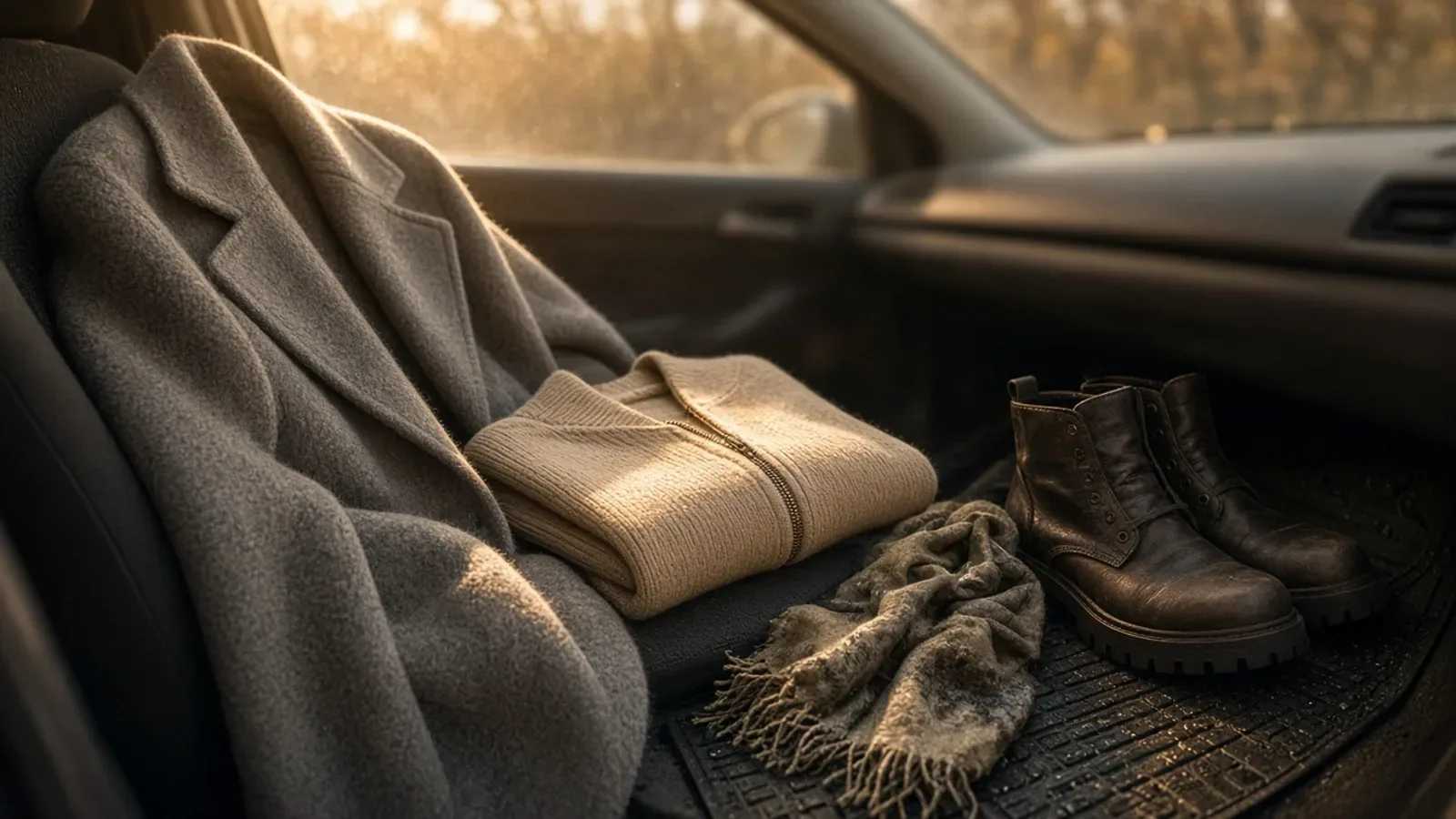
The 7:40 problem is never the outfit in the mirror
You dress at 7:20 in a warm bedroom and the mirror gives a clean verdict. Charcoal knit, wool coat, boots. Good. Then the wind comes round the corner of the school building at 7:52 and the verdict is overturned in about four seconds.
The mirror measures one thing: how you look standing still in a heated room. The school run is five temperatures in forty minutes. Warm car, cold seat belt buckle, wet pavement, a gate where you stand for fifteen minutes doing arithmetic on whether you can feel your hands.
Nothing in that sequence is a standing-still problem, which is why another knit does not fix it. It is why you can own a good coat and still be cold at 8:05.
The feeling you are chasing off is specific. It is the small fury of being cold in an expensive coat. You bought it to stand still in and you are never standing still.
The three-transition rule
| Element | What to check | Pass mark |
|---|---|---|
| Coat sleeve | Reach on the steering wheel | Hands sit at ten and two without pulling at the elbow |
| Coat hem | Clearance over a wet kerb | Roughly a hand’s width above the pavement |
| Coat shoulder | Seam position over the layer beneath | A seam no more than a thumb’s width past the shoulder |
| Boot sole | Grip on wet leaf and gravel | Deep lugged rubber with visible tread lines |
| Boot heel | Balance on gravel | A wide block heel rather than a slim one |
| Boot entry | Removal one-handed at the door | Comes off without sitting down or using both hands |
| Socks | Warmth in a damp boot | A thin liner under a wool sock, two layers in total |
Count the transitions instead of the outfit. Car, pavement, gate, back to the car, then a desk or a supermarket trolley or a kitchen counter.
Then dress for the hardest transition, not the average. The average of a heated car and an exposed gate is a lukewarm nothing, and a lukewarm nothing is what an average outfit gives you.
The gate is the hardest, so the gate decides your base layer and your socks. But the car decides the coat, because the car is the only place where a coat can be actively in your way. A coat thick enough to be warm standing still will hold your arms off the wheel and turn your shoulder check into a shrug. You know this already. It is the reason you have done a one-handed reverse park with a sleeve bunched at the elbow, steering from the forearm.
Ask yourself one question at 7:20: which of the four transitions do I actually fear? Nine times out of ten it is the gate, and you have been dressing for the car because the car is where you look at yourself.
The coat rule, and the layer that buys the warmth back
Here is the rule, plainly: choose the coat you can drive in, then buy the warmth back underneath it.
Two tests, both done at the driver’s door rather than the mirror. Sit down, hands at ten and two. If your sleeve pulls at the elbow or the collar rides up your neck, that coat is a passenger. Then open the door and look down: the hem should clear a wet kerb by roughly a hand’s width, so the walk from car to gate is not a wading exercise.
A coat that passes both tests will be thinner than the warmest thing you own. That is fine, because the warmth is not disappearing, it is moving one layer in. Wool earns its place here for a physical reason rather than a luxury one: Woolmark’s fibre reference describes wool as absorbing moisture vapour from the body and buffering temperature change, which is the exact behaviour you want in a garment that goes from a heated car to a cold gate and back again. A fine-gauge merino crew or a thin wool zip layer under a wool coat will keep you warmer than a second padded coat, and it will not fight the steering wheel.
Check the shoulders before anything else. If your body has changed shape in the last few years, the coat is usually the last thing to catch up, and a shoulder seam sitting a thumb’s width too wide will make every layer under it feel tight. Dressing the body you have now starts with the outer layer, not the jeans.
My rule is the steering wheel test before the mirror test. The mirror has never once told me the truth about a coat.
Feet: two pairs of socks, one sole, no spare shoes in the footwell
The two-pair rule has nothing to do with boots. It is two pairs of socks, a thin liner and a wool sock over it, which is the cheapest warmth in the whole outfit and the reason a wet toe does not become a cold toe by 8:10.
Then the boot, which is doing the work a coat usually does. Look at the sole, not the shaft: you want deep lugged rubber with visible tread lines, because the school gate in November is a sheet of wet leaf. A wide block heel stays upright on gravel. A slim heel does not, and you will feel it in your ankle before you feel it in your dignity.
The boot should also come off without a fight, since you will be pulling it off one-handed while holding a bag and a lunchbox. If you have to sit down and use both hands, it is the wrong boot, however good it looks. This is the one place where spending is genuinely rational, because the boot is worn five days a week for six months, and cost per wear rewards the pair you wear to death rather than the pair you save.
Skip the second pair of shoes in the footwell. Once you factor in the wet umbrella, the water bottle and the scooter, the footwell has no room, and the shoes you keep down there will be cold and damp anyway. Wear the boot that survives.
The five-outfit grid
Three slots, five combinations, and the 7:20 decision disappears.
Slot one is the drivable coat. Slot two is the swing layer, meaning the thing you take off in the car and put back on at the gate: a zip cardigan, a quilted vest, a fine merino crew with a collar that survives being pulled over your head in a car seat. Slot three is the weatherproof boot.
The colour logic is what makes it multiply instead of pile up. Pick one dark base (charcoal, navy, black), one warm neutral (camel, oat, stone), and one metal you repeat in your earrings and your boot hardware. That is it. Every top goes with every bottom and every coat, and the outfit formulas that kill decision fatigue work because the palette is doing the thinking.
So: charcoal coat, oat zip cardigan, dark knit, black boot. Camel coat, charcoal merino, black boot, gold earring. Charcoal coat, grey merino, same boot. Camel coat, oat vest, same boot. Dark coat, dark knit, same boot and a scarf you can throw on in one movement rather than arrange. If a scarf needs adjusting at the gate, it is not a scarf, it is a chore. A snood solves this in one loop.
Stop buying three things. The beautiful coat you cannot drive in. The white trainer, which dies in the first wet week of November and takes your mood with it. And the decorative scarf, for the reason above. If you want to know what a blend is actually made of before you pay for it, Textile Exchange publishes a fibre and materials reference, and it is worth ten minutes the next time a label says wool-rich.
In a warm climate or a southern-hemisphere spring, the same three transitions hold and only the slots change. Swap the drivable coat for a drivable overshirt or unlined blazer, keep a removable layer for air conditioning in the car and the classroom, and move the weatherproofing into the boot, since the wet is the only real enemy. There is a hard element in every version of this uniform, and in summer it is the shoe. The high-low uniform makes the same argument in a different season.
Today, before you buy anything: sit in your car in the coat you wore this morning, hands at ten and two. If your arms do not reach, that coat has been costing you every morning this month. Move it to the weekend. Then put two pairs of socks by the door.
Direct answers
Frequently asked questions
What is the single most important piece of a winter school run outfit?
The coat, but only because it constrains everything else. It has to let you reach a steering wheel and turn your head, and its hem has to clear a wet kerb. Once those two tests pass, the warmth comes from a thin wool layer underneath rather than from coat thickness.
How do I stay warm at the school gate without overheating in the car?
Use a swing layer: a zip cardigan, quilted vest, or fine merino crew you can remove in the car seat and put back on before you open the door. One garment, two temperatures, and nothing extra to carry.
Do I need a second pair of shoes in the car?
No. A weatherproof boot with a deep lugged rubber sole and a wide block heel handles the walk from car to gate and back. Two pairs of socks, a thin liner plus a wool sock, keep your feet warm even when the boot gets wet, and they take up no space in the footwell.
Does the three-transition rule work in warm weather?
Yes. The transitions stay the same, only the slots change. Swap the drivable coat for an overshirt or unlined blazer, keep a removable layer for air-conditioned cars and classrooms, and put the weatherproofing into the shoe.
About the author

The editorial voice of CiciTrends. Color, fit, and the small decisions that make a wardrobe work. Written by an AI-assisted desk under human direction.
Reporting, sourcing and AI disclosure:/editorial-standards/
Keep reading
Related stories
The winter capsule wardrobe
Ten pieces, one winter, and the math that makes them work: coat, knits, bottoms, boots, and the formulas that turn them into a week.
Nov 5, 2026

Winter wedding guest outfits by color season
A winter wedding is a color problem and a layering problem. Here is the guest outfit formula for all 12 color seasons, with specific palette colors and one coat rule.
Nov 4, 2026
Your Perfect Capsule Wardrobe Colors: A Seasonal Guide
Build a cohesive, mix-and-match capsule wardrobe using the colors that flatter your unique seasonal coloring. Never wonder if pieces go together again.
Jan 4, 2026