Invisible mending: what it can and cannot fix
In short
Reweaving a moth hole is not the same as fixing a felted jumper. What invisible mending can repair, what it cannot, and when the math favors repair.
- A $90 repair on a coat worn for five more winters is good value; a $60 repair on a $40 jumper is not, so compare the quote with replacement cost first.
- Reweaving suits woven fabric and Swiss darning follows the loops of a knit, so ask which technique a mender intends before agreeing to the quote.
- Mending cannot restore felted wool, a large missing area, a rotten lining or a high-synthetic blend; those garments need a visible repair, a structural fix or replacement.
By Cici
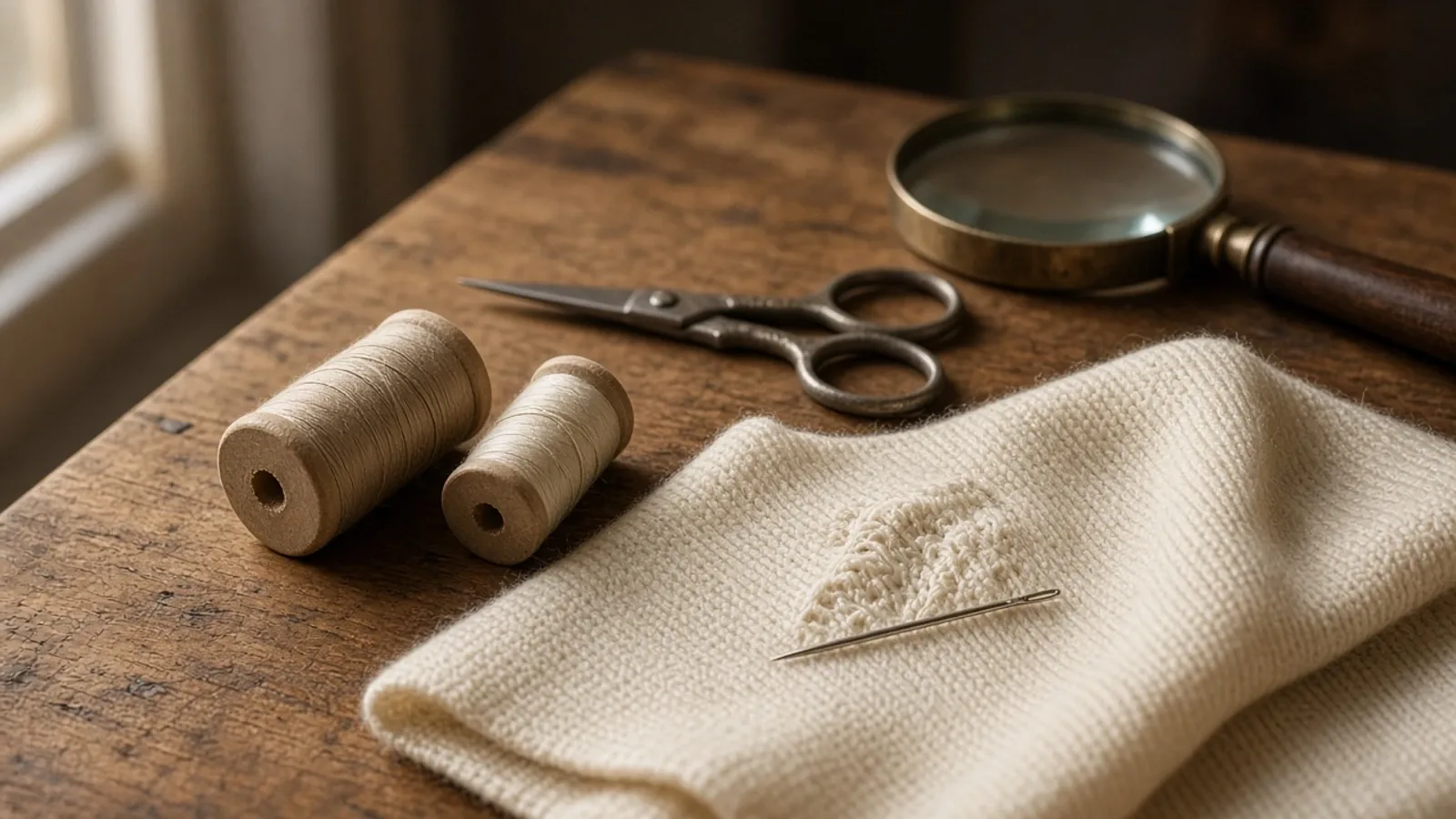
Invisible mending is the repair that tries not to be seen. A moth hole in a cashmere sweater is rewoven thread by thread; a snag in a wool suit is reknitted into the surrounding fabric. The goal is not a visible scar but a piece that looks whole again.
It is also not magic. Invisible mending has limits, and knowing them saves you money and disappointment.
What it is
There are two related techniques:
- Reweaving — used on woven fabrics. Threads from a seam allowance or a matching source are woven into the damaged area.
- Reweaving / Swiss darning — used on knits. The repair follows the loops of the knit so the patch blends into the pattern.
A good mender will tell you which one your garment needs, or whether it needs a visible repair instead.
What it can fix
- Small moth holes in wool, cashmere, and other knits.
- Snags and pulls that have not become a hole.
- Small burns where the fabric around the damage is stable.
- Seam and hem repairs that do not require matching the surface.
- A tear along a seam where the fabric itself is intact.
The best candidates are well-made, clean, and structurally sound. A repair on a garment that is already thinning everywhere is a temporary fix.
What it cannot fix
- A large missing area. The bigger the hole, the more the repair becomes a patch.
- Felted or matted wool. Once the fibres have locked, the original texture is gone.
- Structural damage. A rotten lining, a failing shoulder, or a torn pocket bag is a different repair.
- Cheap blends. A high-synthetic blend may not hold a reweave, and the cost can exceed the value.
- Stains that have weakened the fabric. The repair may look worse than the stain.
- A fit problem. Mending is not tailoring.
| Damage | Can it be hidden? | Realistic repair |
|---|---|---|
| Small moth hole in wool or cashmere | Usually | Reweaving follows the knit loops and blends in |
| Snag or pull that has not opened | Yes | Reweave before it becomes a hole |
| Large missing area | No | The repair becomes a patch; weigh up replacement |
| Felted or matted wool | No | The locked fibres cannot be restored |
| Rotten lining or failing shoulder | Not by a mender | Needs structural repair, not reweaving |
| High-synthetic blend | Unlikely | A reweave may not hold and can cost more than the piece |
Repair or replace?
Run the math:
- What did the piece cost? Not the original price if it was a gift; the replacement cost today.
- What is the repair quote? Ask for a range before you commit.
- How many wears will you get? The 30-wear rule is a useful floor.
- Is the rest of the garment sound? If the elbows are thin and the seams are failing, repair is a stopgap.
A $90 repair on a coat you will wear for five more winters is a good deal. A $60 repair on a $40 jumper is not.
The cost-per-wear guide is the longer version of that math.
Finding a mender
- Ask a good dry cleaner. Many have a mender or can recommend one.
- Ask a tailor. Tailors often know who does reweaving in the area.
- Check a local repair café. They may not do invisible work, but they can point you to someone who does.
- Ask the brand. Some knitwear brands offer repair services or partner with specialists.
- Look for before-and-after photos. Invisible mending is a skill; the portfolio matters.
Get a quote and a timeline. A good mender will be honest about whether the repair will be invisible.
DIY basics
You can learn visible darning at home. True invisible reweaving on fine knitwear is a specialist skill, but these are worth learning:
- Darning — a woven patch over a hole, using a matching thread.
- Swiss darning — following the knit loops to mimic the original stitch.
- Seam repair — closing a split seam with a matching thread.
- Button and hook repair — the simplest fix with the highest return.
Practice on a garment you do not love. A first repair is a learning repair.
Care after repair
- Wash gently. Hand wash or a delicate cycle, inside out.
- Avoid heat. High heat can shrink the repair and the garment.
- Store folded. Hangers can stretch knitwear.
- Check the repair. If it starts to pull, stop and have it fixed again.
The three-jacket wardrobe and the capsule wardrobe guide are built on the same premise: fewer, better pieces, maintained.
Collecting the repair
Collect it in daylight, by the window rather than under the shop’s warm bulbs. Hold the garment at arm’s length, then close. A good reweave reads as texture, not as a patch: you want the same softness under your thumb and no ridge where the repair meets the cloth. Run your finger across it, then along the seam beside it. If the fabric puckers, the tension is wrong and the mend will pull the first time you wash it.
Ask two questions before you pay. What happens if it opens again, and how long is the work guaranteed for? A mender who stands behind the work will answer plainly, and I would rather have that guarantee on paper than a shrug. At home, turn the piece inside out and look at the back of the repair. Neat finishing there separates a mend that lasts from one that only photographs well.
Then fold it into the drawer and leave it for a week. When you take it out on Monday morning, check the repair in the mirror before you leave the house. If the edge has started to lift, you still have time to take it back, and the small relief of a garment that looks whole again is worth the trip.
Who this is not for
If the garment is fast fashion with a failing seam and a low replacement cost, repair may not be worth it. If the piece is sentimental but unwearable, a textile artist can turn it into something else; that is a different project.
And if the damage is from pests, treat the storage problem first. Mending a jumper without dealing with moths is an expensive loop.
Method and limits
This is a repair guide derived from the CiciTrends wardrobe and cost-per-wear principles. The sustainability context is supported by the Ellen MacArthur Foundation’s textiles work. Repair quotes vary by city and garment; always ask before committing, and get the quote in writing.
Sources
- Ellen MacArthur Foundation. A New Textiles Economy.
Direct answers
Frequently asked questions
What is invisible mending?
Invisible mending is a repair technique that reweaves or reknits a damaged area so it blends into the surrounding fabric. It is used on knitwear, wool, and some woven garments, and it is different from visible darning or patching.
Can invisible mending fix a large hole?
It depends on the fabric and the size. Small moth holes and snags can often be rewoven. Large holes, felted wool, and structural damage are harder or impossible to make truly invisible; a visible repair or replacement may be the better answer.
Is invisible mending worth the cost?
Compare the repair quote with the replacement cost and the wear you will get from the piece. For a well-made coat or cashmere knit you love, repair often wins. For a fast-fashion item with a failing seam, it usually does not.
Can I learn invisible mending at home?
You can learn basic darning and Swiss darning from videos and books. True invisible reweaving is a specialist skill, especially on fine knitwear. Practice on a garment you do not love first.
About the author

The editorial voice of CiciTrends. Color, fit, and the small decisions that make a wardrobe work. Written by an AI-assisted desk under human direction.
Reporting, sourcing and AI disclosure:/editorial-standards/
Keep reading
Related stories
Visible mending: make the repair part of the piece
Sashiko, decorative darning, and creative patching turn damage into a design decision. A beginner's guide to the techniques, the kit, and the first project.
Jan 3, 2026

The 30-wear rule: the shopping filter that survives a sale
Will you actually wear it thirty times? The rule, the math, the five questions to ask before you buy, and the exceptions worth making.
Dec 31, 2025

The Cost-Per-Wear Audit: What Your Wardrobe Actually Costs
A cost-per-wear audit turns a closet full of maybes into a decision. The formula, the thresholds, and the one number most shoppers never calculate.
Dec 30, 2025