The low-maintenance hair routine that actually works
In short
A ten-minute morning is a haircut, a wash schedule, and three products — not a shelf of serums. The routine, the order, and what to stop doing.
- A trim every eight to twelve weeks costs less than a repair, because split ends travel up the shaft and a grow-out plan belongs to the cut, not to the styling.
- Wash to the scalp's schedule: every one to two days for an oily scalp, less often for a dry one, and rinse after sweating rather than washing out of habit.
- Three products are enough: a shampoo for the scalp, a conditioner from mid-lengths down, and one leave-in or oil on the ends, with heat protectant only if you use heat.
- Squeeze water out with a microfiber towel or cotton T-shirt, comb from the ends upward, and skip the heavy towel wrap, which stretches the strand.
By Cici
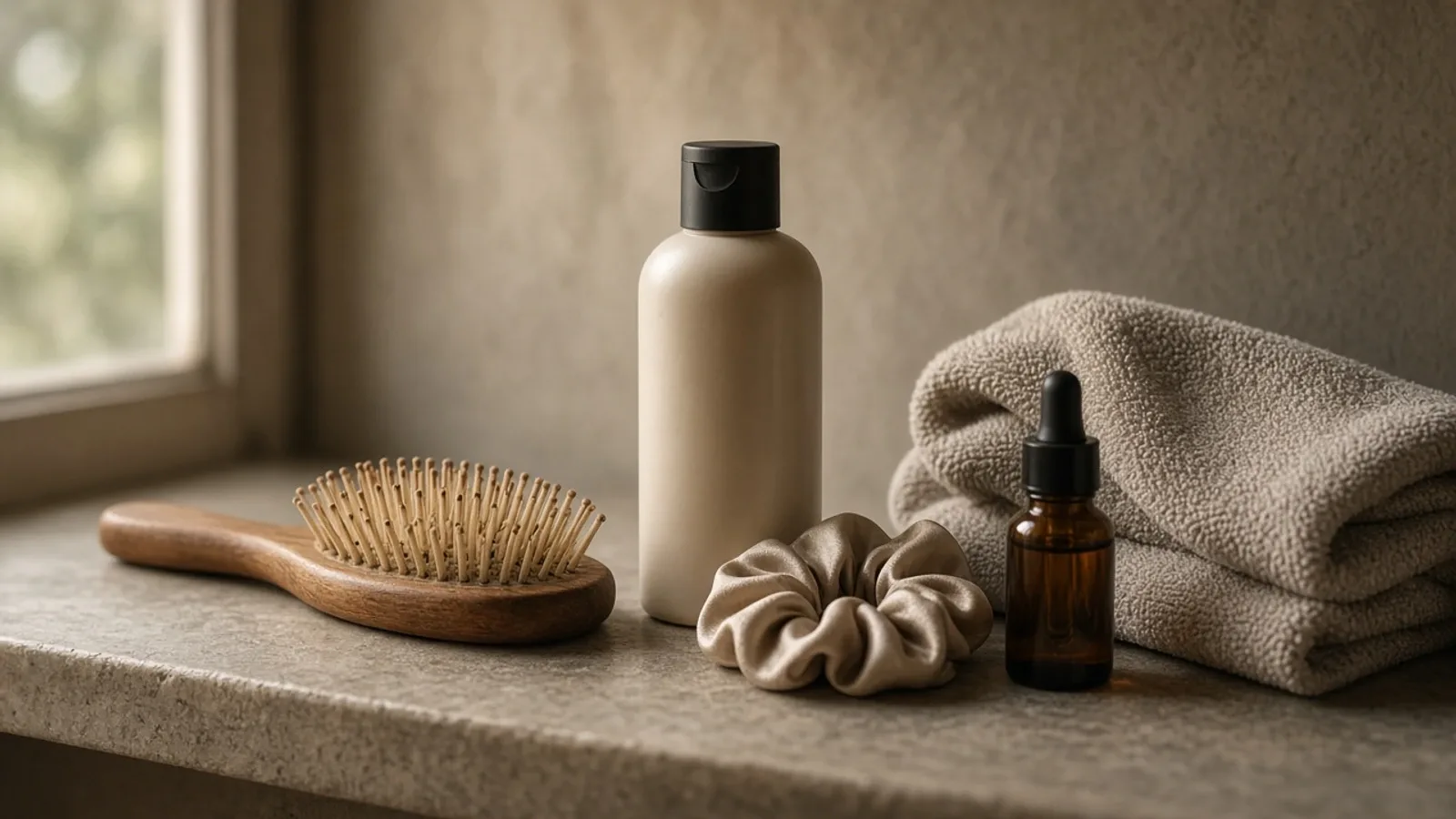
Low-maintenance hair is not a product category. It is a set of decisions made before you get in the shower: the cut, the wash schedule, the products, and the drying method. Get those right and the morning takes ten minutes. Get them wrong and no serum will save it.
Start with the cut
The cut is the routine. A shape that grows out well and air-dries predictably does more than any styling tool.
- Choose a shape, not a length. A blunt bob, a shoulder-length cut with a few long layers, or a curly cut that works with your texture. The shape should hold without daily heat.
- Ask for a grow-out plan. A good stylist will tell you how the cut will look in eight weeks, not just on the day.
- Match the cut to your texture. Straight hair can carry a blunt line; curls need a shape cut dry or curl-by-curl. A cut that fights your texture will always take longer.
- Book the trim before you need it. Split ends travel up the shaft. A trim every eight to twelve weeks is cheaper than a repair.
Wash at the frequency your scalp needs
There is no universal wash schedule. It depends on oil production, product use, and scalp condition.
- Oily scalp: wash every one to two days with a gentle shampoo.
- Dry scalp: wash less often, use a gentler surfactant, and avoid very hot water.
- Frequent exerciser: rinse or wash after sweating, especially if you are prone to flakes.
The scalp is skin, and the same barrier logic applies. The scalp guide covers flakes, seborrheic dermatitis, and when to see a clinician. If your scalp is itchy or flaking, treat that first; a low-maintenance routine on an irritated scalp will not work.
Use three products, not ten
- A shampoo that suits your scalp. Not the most fragranced, not the most expensive. The one that cleans without stripping.
- A conditioner for the ends. Apply from the mid-lengths down. Conditioner on the scalp can weigh hair down and contribute to build-up.
- One leave-in or oil for the ends. A lightweight leave-in on damp hair, or a few drops of oil on dry ends. That is the finishing step.
Everything else — the heat protectant, the texture spray, the serum — is optional. If you use heat, use a protectant. If you do not, you do not need one.
Dry with intention
- Squeeze, do not rub. A microfiber towel or a cotton T-shirt reduces friction and frizz.
- Air-dry when you can. If you have twenty minutes, let it dry while you do something else.
- Blow-dry with direction. Point the nozzle down the shaft to smooth the cuticle. Rough-drying makes frizz.
- Do not brush wet hair aggressively. Use a wide-tooth comb or your fingers, starting at the ends.
If you color your hair, the gloss, glaze, and toner guide explains which services are gentlest and how often to refresh. If your hair is thinning, the scalp guide covers what is worth investigating.
The wash-day routine
Wash day should be the longest part of the week, not the most complicated.
- Shampoo the scalp, not the ends. Work the lather into the scalp with your fingertips, then let it rinse through the lengths.
- Rinse thoroughly. Product residue is a common cause of dullness and build-up.
- Condition from the mid-lengths down. Comb it through with your fingers or a wide-tooth comb, then rinse with cooler water to help the cuticle lie flat.
- Squeeze out the water with a towel or T-shirt before applying leave-in. Product absorbs better on damp, not dripping, hair.
- Air-dry or rough-dry depending on time. Do not wrap the hair in a heavy towel for an hour; it stretches the strand.
That is the whole wash day. The rest of the week is refresh and shape.
The ten-minute morning
- Refresh, do not re-wash. A little water or dry shampoo at the roots, then rough-dry or smooth.
- Add one product. A leave-in or oil on the ends.
- Choose a shape. A claw clip, a low bun, a ponytail, or a quick blow-dry. The shape is the style.
- Deal with the front. The front is what people see. A quick smooth or a few face-framing pieces is enough.
- Stop. The last five minutes of fixing usually make it worse.
What to stop doing
- Buying a new product for every problem. Most hair problems are cut, scalp, or heat damage.
- Washing every day out of habit. Wash when the scalp needs it, not because it is morning.
- Applying conditioner to the scalp. It weighs hair down and can cause build-up.
- Tight hairstyles every day. Traction damage is real; rotate the parting and loosen the updo.
- Chasing “glass hair” with heat. Shine comes from cuticle health, not a hotter iron.
| Symptom | What it usually means | First change |
|---|---|---|
| Dullness and build-up | Product residue left in the hair | Rinse thoroughly and condition only the mid-lengths down |
| Frizz | Rubbing and rough drying | Squeeze with a towel, then point the nozzle down the shaft |
| Flat, weighed-down hair | Conditioner applied to the scalp | Keep conditioner from the mid-lengths down |
| Breakage and stretching | Brushing wet hair, long towel wraps | Comb from the ends with a wide-tooth comb, no heavy wrap |
| Traction damage at the hairline | Tight hairstyles worn every day | Rotate the parting and loosen the updo |
| Split ends | Ends travelling up the shaft | Trim every eight to twelve weeks |
Who this is not for
If you enjoy a full styling routine and have the time, keep it. If you have a medical scalp condition, follow your clinician’s plan. If your hair is relaxed, loc’d, or in a protective style, the wash-and-go logic does not apply; the principles (gentle cleansing, moisture, low manipulation) still do.
Sources
- American Academy of Dermatology, Seborrheic dermatitis: treatment.
- Li T, Yao D, Cheng F, Mou X, Bian Q. The Scalp Microbiome–Hair Axis: Mechanisms and Therapeutic Translation. Research, 2026.
Direct answers
Frequently asked questions
How often should I wash my hair if my scalp gets oily?
Every one to two days with a gentle shampoo, and cooler water rather than very hot. Wash when the scalp needs it rather than out of habit, because a fixed daily wash can strip a scalp that did not need washing that day.
Which haircut needs the least styling in the morning?
A shape that grows out well and air-dries predictably, such as a blunt bob, a shoulder-length cut with a few long layers, or a shape cut for your texture. Ask the stylist how it will look in eight weeks.
How many hair products do I actually need?
Three: a shampoo that suits your scalp, a conditioner for the mid-lengths and ends, and one leave-in or oil for the ends. Everything else, including heat protectant, texture spray and serum, is optional unless you use heat.
Should I brush my hair when it is wet?
No. Wet hair stretches and snaps, so use a wide-tooth comb or your fingers and start at the ends. Squeeze the water out with a microfiber towel or cotton T-shirt instead of rubbing, and never wrap wet hair in a heavy towel.
About the author

The editorial voice of CiciTrends. Color, fit, and the small decisions that make a wardrobe work. Written by an AI-assisted desk under human direction.
Reporting, sourcing and AI disclosure:/editorial-standards/
Keep reading
Related stories
Lipstick by color season: the shades that work
Most lipstick advice fails because it ignores undertone and contrast. A practical map of the 12 seasons, the reds, the nudes, and how to test in daylight.
Jan 7, 2026
Hair gloss vs glaze vs toner: what each one actually does
The three treatments are sold as interchangeable. They are not. Here is what each one deposits, how long it lasts, and which one your hair actually needs.
Nov 4, 2026
How to reset your skin barrier (without stopping everything)
A barrier reset is not a week of doing nothing. It is removing the irritants, keeping the basics, and giving the skin time to recover.
Dec 30, 2025