The $50 Rule: Gifts That Read Expensive Because They Get Used
In short
Most gifts under $50 fail because they're novelties. Spend the budget on one daily object — a better mug, a better cream — and skip what needs explaining.
- Spend the whole $50 on one object the recipient touches most days, because splitting it three ways buys the supermarket version they already own.
- Choose a visibly better version of an ordinary object: better weight, finish, and proportion, rather than something more decorated or more explained.
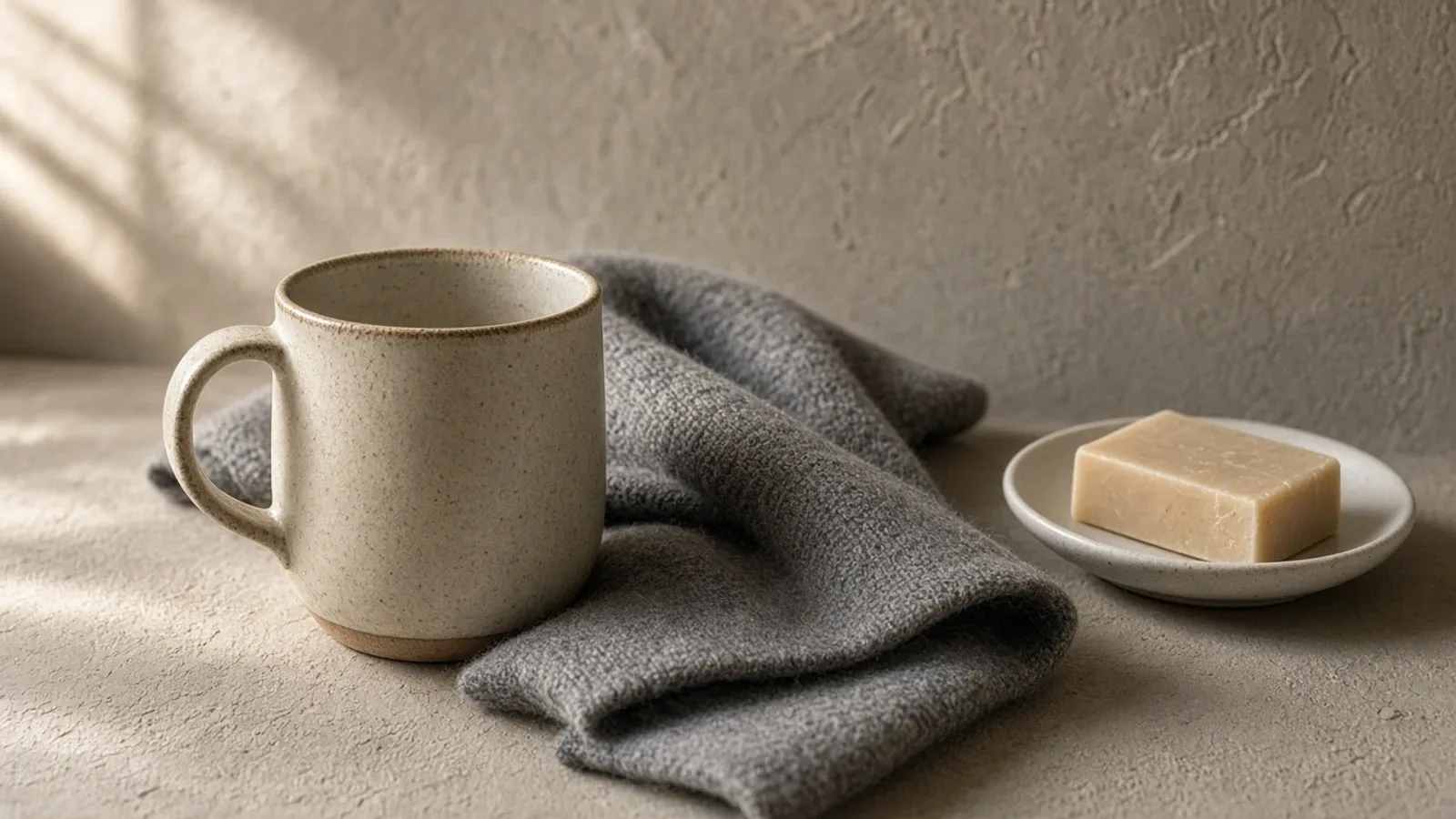
- Check a mug against three tests: it sits flat without rocking, two knuckles fit the handle, and the rim is thin enough to read refined.
By Cici
The rule, up front
Spend the whole $50 on one object the recipient touches most days, and skip anything that needs explaining. That is the entire argument; the rest is the working-out.
You have seen the pattern. The box is lovely, the paper is heavy, and by the third week the object is in a drawer behind the batteries. Most gifts under $50 fail for reasons that have nothing to do with budget. The first is that they are built around the unwrap rather than the months after it. A novelty peaks at the moment of surprise, then has to keep working when nobody is watching: the joke mug is a heavier, worse-proportioned mug than the one already in your friend’s cupboard. The second failure is explanation. If handing it over requires a sentence that starts with “it’s a…”, your friend spends the next thirty seconds performing appreciation instead of feeling it. Anything carrying a caveat has already asked something of the person receiving it.
Put the whole $50 on one object
The arithmetic does more work than the taste. Split $50 across three items and each lands near $17, which in most categories buys the version the recipient already owns: the supermarket mug, the pharmacy hand cream, the dish towel from a multipack. Put the same $50 on a single object and you reach the top of the ordinary tier, or the entry point of the good one.
Frequency finishes the job. A mug you reach for twice a day gets roughly 730 contacts a year, so at $50 you are paying under seven cents a touch. A $50 gadget you use four times costs $12.50 a use. That is arithmetic, not a study, and it is offered as an argument rather than a finding. It also explains why a good mug outlasts a novelty in the cupboard as well as in memory.
The comparison is the mechanism. A gift registers as generous when it is visibly better than the version your friend would have bought for themselves: more weight in the hand, a finish that stays smooth under the thumb, a proportion that looks deliberate rather than decorated. That is a styling judgment rather than a measured result, and it is the lens the rest of this piece uses.
Ceramics: what separates a mug from a souvenir
The case for the coffee mug as a gift rests on duration rather than luxury: it is the present still in use years later. That is a higher bar than “looks nice on a shelf,” and it is the test the rest of this section applies.
The physical tells below are what tend to separate a considered mug from a souvenir, and you can check all of them in a shop in under a minute.
- Base weight and foot ring. Set the mug down on a bare table. A flat, wide foot ring keeps it from skidding and makes it feel planted; a mug that rocks slightly reads cheap immediately, whatever the glaze.
- Glaze behaviour. Drag a thumbnail across the inside. Reactive and satin glazes tend to disguise cutlery scratches and spoon marks, while high-gloss white shows every one, and a matte white rim is usually the first place staining appears.
- Handle clearance. Hook two fingers through the gap. They should both fit, and the handle should sit high enough that your knuckles do not graze the hot body. A handle that only takes two fingertips belongs on a smaller mug.
- Rim thickness. Run a thumb around the rim. A thin, slightly tapered edge feels refined against your lip; a thick rolled one feels like a diner.
- Volume. Ten to twelve ounces covers most coffee drinkers. Eight reads small to anyone who fills a mug to the top.
Under $50, the reliable places to look are studio potters’ seconds, restaurant-supply stoneware, and end-of-line stock from a brand that normally sits above your budget. Seconds come with uneven glaze and usually no exchange policy, which is fine for a close friend who will find the flaw charming and wrong for a colleague.
The consumable: one full-size, not a trio
The distance between a $12 cream and a $45 cream is usually in the vessel and the fragrance rather than the formula. Unscrew the cap in the shop and smell it: if it reads like a hotel lobby, you have found where the money went. The budget beauty breakdown covers where that gap tends to open and where it closes.
A three-piece set splits the perceived value across three vessels your friend has to store somewhere, and two of them typically go unused. One full-size tube does something a set cannot: it says a habit was noticed. Hand cream by the kitchen sink, bar soap in a shared bathroom, one decent body oil for someone who has mentioned dry legs in January. A single object is a conclusion; a set is a guess.
Go fragrance-free unless you know the recipient’s taste. Scent imposes a preference, and a scented consumable your friend did not choose is the likeliest reason a good one goes unused. If the point is care rather than luxury, the budget self-care argument applies: the cheap version done consistently beats the expensive version done once.
The accessory at the price floor
The luxury-under-$50 bracket works the same way from the accessories end, across homeware and small leather goods. It holds up where the material is honest: a silk or wool scarf, a leather card case, a cotton canvas pouch, a good pair of wool socks. It gets shakier where the price is met by thinning the material rather than simplifying the design.
Read the label before you read the price. Fibre content has to be stated on the ticket, and the order of the list tells you what you are holding: a scarf that puts polyester first and wool last will feel smooth in the shop and crackle with static by February.
The tell tends to be hardware. Turn the clasp over and look at the back, where plating wears first; that is exactly where a hand rests or a bag strap rubs. Coated leather with a printed grain tends to crease into visible lines within a season. None of that is a defect at $30; it is a defect only if the gift is meant to read as more than it cost.
Metal choice is a separate decision from metal quality, and the gold versus silver undertone test is worth running before buying anything worn near the face.
One object, one box
| Object under $50 | What makes it read expensive | What gives it away |
|---|---|---|
| Stoneware mug | A flat, wide foot ring, two-knuckle handle clearance, and ten to twelve ounces | It rocks on a table, or the handle only takes two fingers |
| Hand cream or bar soap | One full-size, unscented, in a plain vessel | A three-piece set where two vessels go unused |
| Scarf or leather card case | Honest material: silk, wool, or leather | Plated hardware wearing at the friction point |
| Packaging | One object in a box sized to fit it | Three items in a large box, or shredded paper |
Packaging sets the expected price before the object is seen. Three items in a large box read as a hamper; one item in a box sized to fit it reads as a purchase. Wrap it the way a shop would: tissue, a lid that closes flush, a ribbon tied once. Skip the shredded paper, which mostly signals that the box was too big.
Keep the receipt and offer it rather than enclosing it. An enclosed gift receipt tells your friend you expected failure. Say it in one line at the door, and know the fallback: a distance sale can be cancelled within 14 days, so an exchange is usually simple.
What to skip this season
You can run every item on this list through the same test: does it earn its place after the paper comes off?
- The scented candle in a printed tin, unless the recipient burns candles weekly — in which case a plain vessel and a better wax is the upgrade.
- Anything requiring batteries, an app, or a manual.
- Monogrammed items that cannot be exchanged.
- Beauty gift sets assembled around a bag rather than a product.
- The joke mug, the novelty apron, the shaped soap.
- Three of anything, when one better version exists at the same total.
The decision
Name the object your friend touches most days, then check whether the good version of it lands under $50. A mug, a hand cream, a bar of soap, a scarf, a leather card case: the list is short, and the answer is usually already known.
If nothing comes to mind, buy the consumable, one full-size tube of something unscented and well made, wrapped properly. If something does come to mind, buy that one and nothing else. The budget was never the constraint; the number of items was.
Sources
- Le Creuset. Care and use: stoneware.
- GOV.UK. Textile labelling.
- GOV.UK. Accepting returns and giving refunds: the law.
Direct answers
Frequently asked questions
What single question settles whether a gift is worth buying?
Ask what the recipient will do with it in February. If the answer is "use it most days," the object is doing work after the surprise has worn off. If the answer is "keep it somewhere," the gift was built for the unwrap, and no amount of cleverness fixes that.
How do you check a mug in a shop without a checklist?
Three ten-second tests: set it on a flat surface and see whether it rocks, hook two fingers through the handle to check clearance, and run a thumb over the rim. A mug that passes all three feels planted and will not graze knuckles or sip badly, which is most of what separates it from a souvenir.
What is the fallback when the recipient's taste is a mystery?
Buy the object, not the set: one full-size, unscented consumable such as hand cream, bar soap, or body oil, in a plain vessel. Nothing about it requires knowing a colour preference, a scent preference, or a shelf's worth of styling, which is exactly why it survives contact with a real bathroom.
What should happen with the receipt?
Hold it and say so in one line rather than putting it in the box. A receipt inside the packaging reads as a prediction of failure; a receipt offered in conversation reads as confidence plus a safety net, and it keeps the exchange option open either way.
About the author

The editorial voice of CiciTrends. Color, fit, and the small decisions that make a wardrobe work. Written by an AI-assisted desk under human direction.
Reporting, sourcing and AI disclosure:/editorial-standards/
Keep reading
Related stories

The carry-on capsule: eight pieces, five days
Pack a palette, not outfits. Eight pieces, ten combinations, one carry-on, and the color rule that makes every top work with every bottom.
Nov 4, 2026

The Sunday reset: a 90-minute system for the week ahead
Not a whole-day clean, not a productivity performance. A 90-minute Sunday system built on habit research, with an if-then plan that survives Monday.
Jan 3, 2026
How to Wash Wool and Cashmere Sweaters Without Shrinking Them
Wash wool and cashmere sweaters less often, at 30C or cooler, with low spin, and dry them flat. The fiber-first rule that stops shrinking and pilling.
Nov 11, 2026