Micro-hobbies: the 15-minute reset
In short
A micro-hobby is not a side hustle. It is a small, repeatable activity with no output target — and it fits into the pockets of a real week.
- A micro-hobby runs for 10 to 20 minutes with no output target, no monetization plan and no new equipment, which is what separates it from a side hustle.
- Repeat a new micro-hobby three times before judging it: one session is not data, and the benefit comes from repetition and attention rather than from duration.
- Keep the supplies in one basket, drawer or shelf: if they no longer fit, you have too many supplies rather than too little time.
By Cici
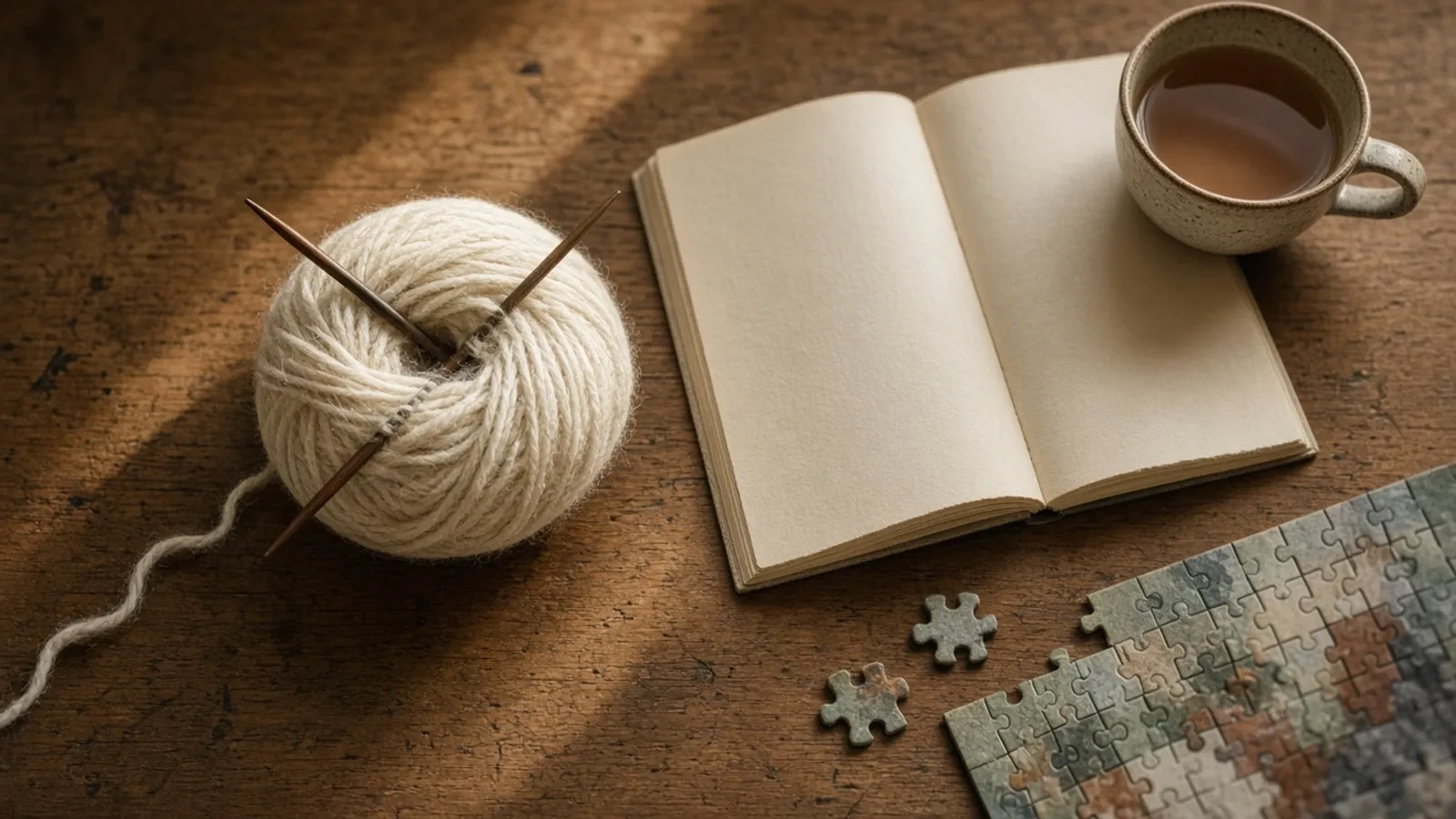
A micro-hobby is not a side hustle. It is not a skill you are monetizing, a content niche, or a self-improvement project. It is a small, repeatable activity you do because you like it.
The 15-minute frame exists because it lowers the barrier. You do not need a free afternoon; you need a pocket of time and a low enough bar to start.
Why short works
- It is easier to start. A 15-minute commitment is small enough to keep.
- It is easier to repeat. Repetition is where the benefit lives.
- It is harder to optimize. A short session resists the urge to turn it into a project.
- It fits a real week. Not the fantasy week with a free Saturday.
The APA’s self-care guidance emphasizes small, sustainable practices over grand gestures. A micro-hobby is that principle applied to leisure.
Twelve ideas
Hands
- Drawing — a page, a pencil, no finished piece.
- Knitting or crochet — a few rows, not a sweater.
- Puzzles — a corner of the table.
- Cooking one new thing — a sauce, a bread, a snack.
Body
- Stretching — five poses, no mat required.
- A short walk — around the block, no podcast.
- Dancing — one song, badly.
- A bath or a long shower — the ritual, not the products.
Mind
- Reading — a few pages of a book, not a feed.
- A language app — one lesson.
- Birdwatching — from a window.
- A musical instrument — one scale, one song.
The self-care on a budget guide has the free version of most of these.
How to start
- Pick one. Not a list. One.
- Put it where you will see it. A sketchbook on the table, a book by the chair.
- Set a 15-minute timer. Not to optimize; to make the end visible.
- Do it badly. The first attempt is not a performance.
- Repeat three times before judging. One session is not data.
The Sunday reset is a good place to choose the week’s micro-hobby. The digital detox guide is the companion rule for keeping the phone out of the 15 minutes.
What not to do
- Do not monetize it. The moment it becomes a business, it stops being a hobby.
- Do not post it. A private practice is allowed.
- Do not buy gear first. Use what you have for a month.
- Do not track it like a habit streak. Missing a day is not a failure.
- Do not turn it into another job. No output target, no deadline.
A menu by energy level
| Energy on the day | What the session needs | Example from the menu |
|---|---|---|
| Depleted | Seated, no setup, no screen | Read three pages or draw circles on a page |
| Low | Floor or bath, fifteen minutes | Stretch on the floor or listen to one album |
| Medium | One contained task at a table | Cook one new sauce or knit a few rows |
| Higher | Moving, outside or to one song | Walk around the block or dance to one song |
| Any level | A 15-minute timer and no output target | Stop when it rings, whatever the result |
The hobby should match the energy you have, not the energy you wish you had.
Low energy
- Read three pages.
- Stretch on the floor.
- Listen to one album, start to finish.
- Draw circles on a page.
- Take a bath without a podcast.
Medium energy
- Cook one new sauce or snack.
- Do a puzzle for fifteen minutes.
- Knit or crochet a few rows.
- Water and repot a plant.
- Write one page in a notebook.
Higher energy
- Walk around the block.
- Dance to one song.
- Practice one scale or one song.
- Try a new recipe from start to finish.
- Visit a park or a library.
The menu removes the “what should I do?” decision. Pick the row that matches the day, set the timer, and stop when it rings.
The one-shelf rule
Keep the hobby in one basket, drawer, or shelf. If the supplies do not fit, you have too many supplies, not too little time.
The shelf does two things: it makes starting easy, and it stops the hobby from becoming another clutter problem. A sketchbook and a pencil on the table will get used; a cupboard of unused materials will not. The hobby is the point, not the shelf or the streak.
Monday, 8:40pm
The dishes are stacked, the kitchen light is too bright, and the drawer with the pencils in it is right there. Take one sheet of paper, turn your phone face down, and set a timer for fifteen minutes. Draw the two pears on the counter badly. You will notice the grain of the paper first, then the scratch of the pencil, then the fact that you have not thought about tomorrow’s school run for six whole minutes. That pause is the hobby doing its job. When the timer rings, close the book and leave the pencil on top of it, so that tomorrow’s start costs you nothing.
Who this is not for
If you already have a hobby you love, you do not need a new one. If you are in a season where 15 minutes is not available, rest is the hobby; do not add another obligation.
And if you are struggling with persistent low mood or anxiety, a micro-hobby is not a treatment. The NIMH’s mental health guidance is a better starting point, and a clinician can help.
Method and limits
This is a leisure guide derived from the CiciTrends self-care and routine principles. The wellbeing context is supported by the APA’s self-care guidance and a 2026 narrative review of leisure activities and cognitive reserve. It is not a clinical prescription.
Sources
- American Psychological Association. Self-care.
- Rizzuti M, Berretta E, Gosti V, Baglioni C, Serra L, Gelfo F. Leisure Activities: A Narrative Review of Established Evidence and New Perspectives on the Cognitive Reserve Framework. Brain Sciences, 2026.
Direct answers
Frequently asked questions
What is a micro-hobby?
A micro-hobby is a small, repeatable leisure activity that fits into 10–20 minutes. It has no output target, no monetization plan, and no equipment requirement beyond what you already own.
Do 15 minutes of a hobby actually help?
A short session can still provide a mental break, a sense of agency, and practice. The benefit comes from repetition and attention, not from duration. It is not a substitute for treatment if you are struggling.
What are good micro-hobbies?
Drawing, knitting, stretching, a puzzle, a language app, birdwatching, cooking one new thing, playing an instrument, or reading a few pages. The best one is the one you will repeat.
How do I stop turning a hobby into productivity?
Remove the output target before you start: do not post it, sell it, optimize it, or track it as a streak. The point is the activity, not the result, and a hobby that produces nothing is still working.
About the author

The editorial voice of CiciTrends. Color, fit, and the small decisions that make a wardrobe work. Written by an AI-assisted desk under human direction.
Reporting, sourcing and AI disclosure:/editorial-standards/
Keep reading
Related stories
Touch is not a serum: what skin hunger can and cannot fix
Affectionate touch is linked to wellbeing, and pleasant touch has its own nerve pathway. A beauty ritual is nice — it is not a substitute for connection.
Jan 3, 2026
Seasonal depression: what helps, and when to get help
Light therapy has real evidence for seasonal affective disorder. So do therapy and medication. What to try, what to skip, and the signs that need a clinician.
Jan 12, 2026
The realistic digital detox: change the defaults, not your whole life
The evidence on total detoxes is mixed and short-lived. What actually helps is timing, friction, and replacement. A seven-day experiment that fits a real week.
Jan 8, 2026